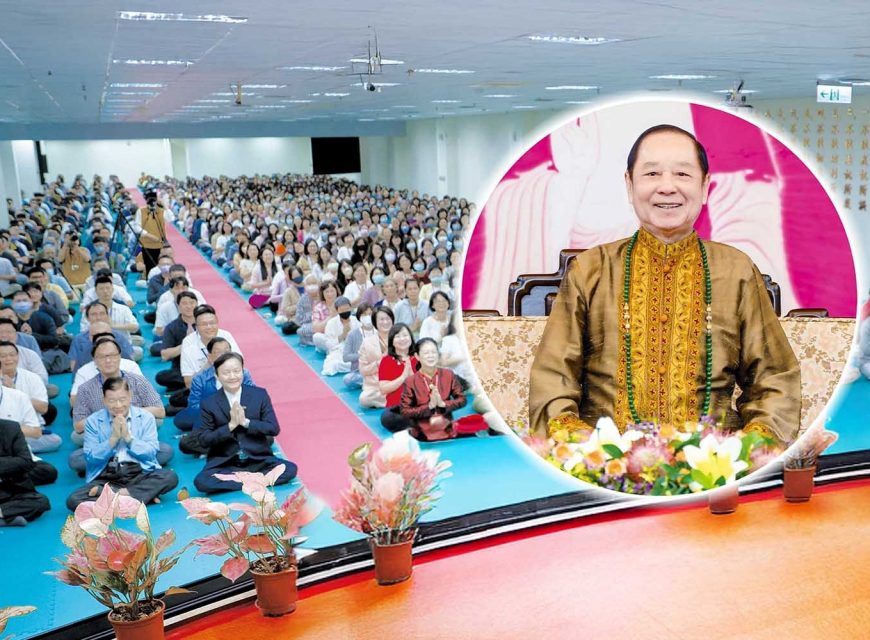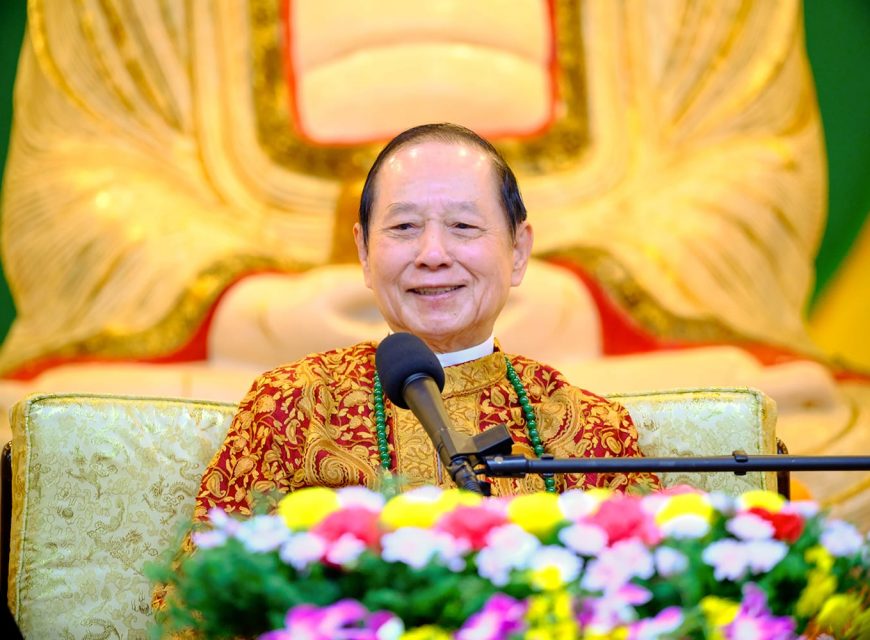

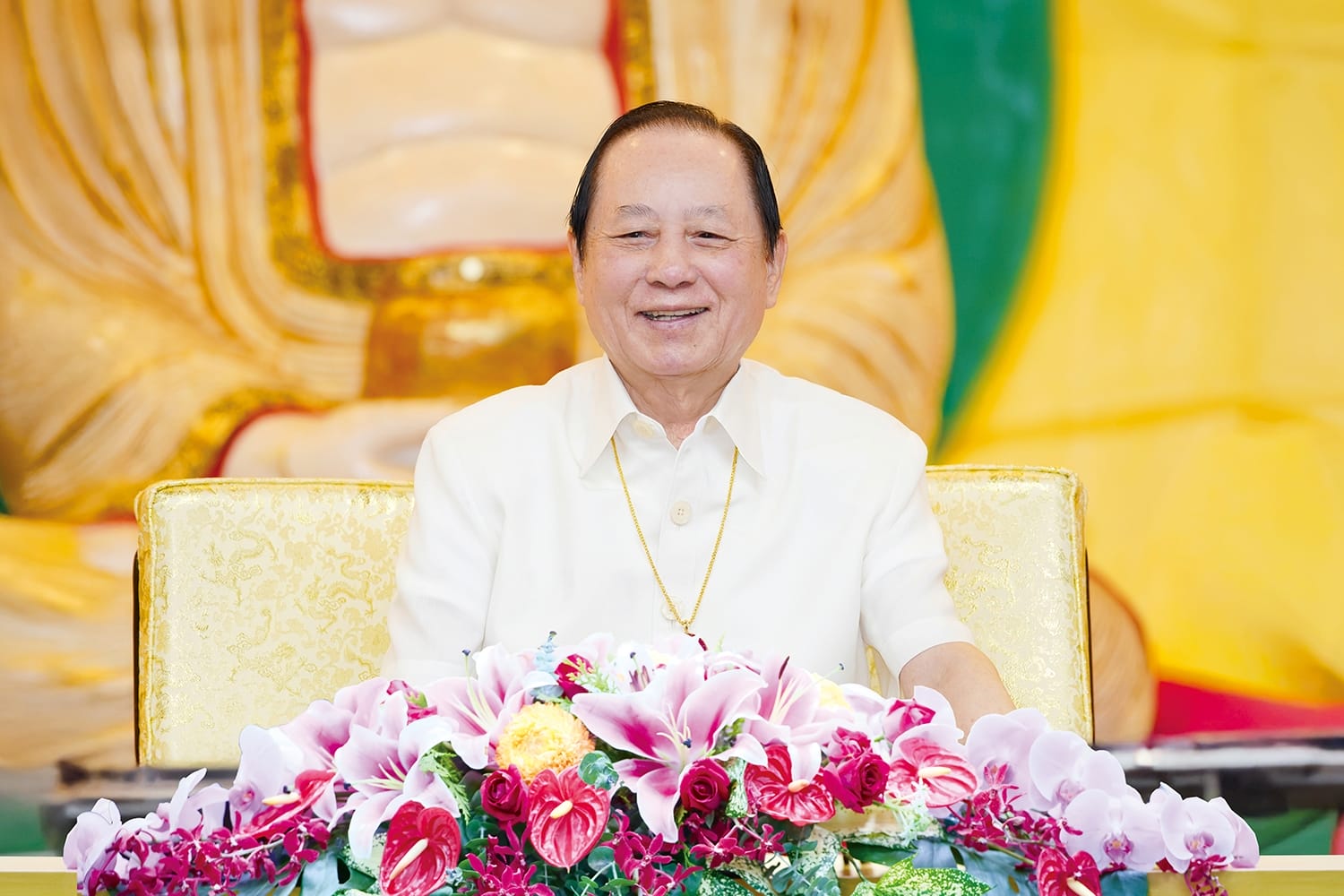
Lecture by: Zen Grandmaster Wu Chueh Miao-Tien, the 85th-generation Grandmaster of the Zen School
How can one practice to reach the realm of wisdom? It is through the practice of the Wisdom Zen Dharma. This method allows us to attain the wisdom of our true nature (true self, self-nature).
How should we practice the Wisdom Zen Dharma? First, we must sincerely accept this precious method from the heart; only then can it lead us into the subtle realm of reality that transcends everything.
The world of Zen is vast and multifaceted; entering the core of Zen wisdom brings endless hope and beauty to life.
Transcending Consciousness – Zen Meditation in the True-Nature Realm Gives Rise to Wisdom
What is the Wisdom Zen Dharma? It is a method that elevates our knowledge and consciousness to the realm of wisdom. How to elevate and transform? That is a question of methodology.
What is the difference between general Zen Dharmas and the Wisdom Zen Dharma? General Zen practices are limited to the level of the consciousness, including practices that enhance physical health and cultivate moral character, among others, which do not transcend the scope of the consciousness. The Wisdom Zen practice must break away from the consciousness and transcend its limits to directly reach the level of wisdom; such a method is the Wisdom Zen Dharma.
The characteristics of Zen include both “movement” and “stillness,” being extremely dynamic yet extremely still. Consider the Earth; it is part of the essence of Zen, with its poles representing “movement,” while its inner core is “still.” Our sensory perception cannot detect the difference between these two because it transcends the range of human sensory activity, just as we live on Earth without feeling its rotation.
Entering the practice of Wisdom Zen Dhamma is akin to entering the core of the Earth, where one feels nothing moving at all. The Earth’s core holds many treasures, just as our depth of wisdom also contains many incredible treasures. To unearth these treasures, we cannot merely scratch shallowly on a hilltop. We have to dig very deep, like you would dig for coal, let alone diamonds or gold?
How can one unearth the treasure of wisdom? It requires practicing Zen meditation to enter the realm of wisdom, where the wisdom within can be uncovered. However, if one remains confined to the level of consciousness and cannot transcend it, it is like digging only on the surface of an entire mountain. No matter how much time is spent digging, the most precious treasures hidden deep inside the mountain cannot be found.
Deeply Rooted Consciousness – Difficult to Shake
Humans and living beings on Earth possess sensory functions, such as vision, hearing, smell, taste, and touch. Through these senses, we perceive various phenomena in our surroundings, which are then transmitted to the realm of consciousness.
Therefore, if meditation is limited to this scope, even if the body is healthy and the mind is balanced, it is still within the realm of consciousness and belongs to ordinary meditation methods, not wisdom meditation methods.
What kind of person is suitable for practicing the Wisdom Zen Dharma? Naturally, it is someone with wisdom. A practitioner of the Wisdom Zen Dharma must possess the determination to transcend consciousness; if one is not wise, they will remain in the world of consciousness and cannot surpass it, making it impossible to enter the realm of wisdom.
If we categorize humans by types of wisdom, as the founding father Dr. Sun Yat-sen remarked, we can divide people into three types: those who are unaware, those who become aware later, and those who are prescient.
The so-called “unaware” do not necessarily have poor knowledge. What is the difference between knowledge and wisdom? For example, a farmer has a piece of land measuring 1 jia (a traditional unit of area in Taiwan). If the price is NT$1,000 per ping (another unit of area), then the value of his 1 jia of land is NT$2.934 million (1 jia = 2,934 ping). After several years, due to changes in social structure and population growth, the land price may increase tenfold, so his land would appreciate to NT$29.34 million.
Logically, this farmer could sell some land to improve his life. However, many old farmers would rather take a hoe and go to the fields to cultivate the land than change their original lifestyle.
Furthermore, if this land later becomes construction land, its value may increase tenfold from the already increased NT$29.34 million to NT$293.4 million. If he sells the land to a construction company, he could live comfortably from now on without the hardship of farming.
From this example, it can be seen that once a person has mentally fixed on a certain pattern, it becomes very difficult to change it.
There is no higher or lower in learning – The wise come first.
Similarly, when we tell a highly educated person with a doctoral degree, “Practicing Zen meditation is very good; practicing the Wisdom Zen Dharma is very beneficial,” some will accept it, while others may not. Conversely, a less educated person might ask, “What is so good about the Wisdom Zen Dharma?” After we explain, they might be willing to practice it.
Thus, in terms of knowledge, the former person with a doctoral degree is more learned than the latter individual with less education. Yet, in terms of wisdom, the less educated person who is willing to practice the Wisdom Zen Dharma may possess higher wisdom than the one with the doctoral degree.
Therefore, it is only the wise who can practice the Wisdom Zen Dharma. The same goes for studying; if one does not engage with a subject, they cannot understand its essence. It’s just like a glass of water or beverage; if one does not drink it, they cannot know its taste.
Cultivating Wisdom Zen – Emerging from the Well of Knowledge
A wise person is not necessarily highly knowledgeable, so regardless of one’s level of education, everyone can practice the Wisdom Zen Dharma and transcend the self in the process. Of course, if one is highly educated and can accept the Wisdom Zen Dharma, the practicing efficiency will be even greater.
If a person often clings to their opinions and is accustomed to their own ideas, living in their own space and mindset, they are like a frog at the bottom of a well, seeing the world only as big as the well opening. One day, if this frog jumps out of the well, it realizes with sudden enlightenment how vast the world beyond the well truly is!
Practicing the Wisdom Zen Dharma allows us to leap out of the well of knowledge into the expansive realm of wisdom. Just like that frog, once it jumps out of the well, the sky it sees is far broader than what it saw inside; if it is at a higher altitude, the sky becomes infinitely vast.
Zen practice is similar; there are many different levels. As long as we are willing to recognize and experience it, we can gradually enter the realm of Zen. Once we transcend the realm of knowledge and the subconscious, we can enter the realm of the Wisdom Zen Dharma.
English Translation: Chueh Miao Gong-Ming and Chueh Miao Dao-Lian