

Question: What is the difference between the Heart-Imprint Zen Dharma and the practices of chanting Buddha’s name and reciting scriptures?
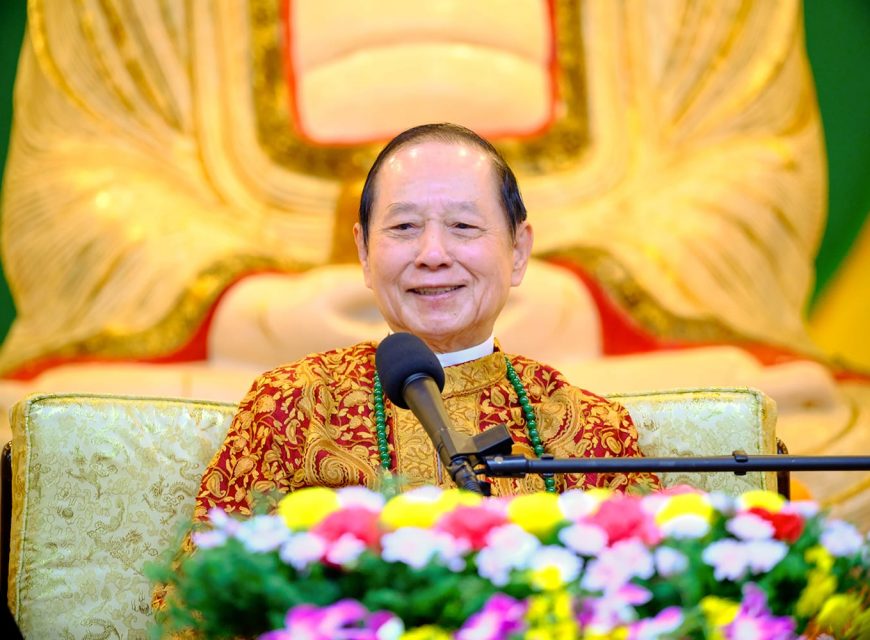
Narration by: Grandmaster Wu Chueh Miao-Tien, the 85th-Generation Zen Grandmaster of the Zen School
(This article is excerpted from a teaching given on October 4, 1993, at the Taipei Jingmei Zen Center, organized by the Heart-Imprint Zen Education Foundation of the Republic of China.)
Practicing Zen meditation using the Heart-Imprint Zen Dharma is equivalent to engaging in implementing the Buddha’s teachings. How so? When you read the Buddhist scriptures or listen to a master explain, you learn what the Western Pure Land is like and what degree of realization the Buddhas and Bodhisattvas have. You hear about the immeasurable lifespan, the immeasurable light, and the immeasurable Dharma body of the Buddhas and Bodhisattvas, which can save all sentient beings and every suffering person in the Saha world. However, you have never seen Amitabha Buddha, nor have you experienced what the world of light is like. You only listen and know in your mind.
When we hear the master say this or read it in the scriptures, we must prove it through Zen meditation. Our Zen meditation is meant to prove the world of Amitabha Buddha and to validate what kind of world the Pure Land of Ultimate Bliss is. This is an implementation of the teachings. We are already practicing, not just listening; we are already doing it. Therefore, listening to teachings is not as effective as engaging in practice; meditation is equivalent to engaging in practice.
Listening to teachings is for beginners, for those who have not yet been exposed to Buddhist teachings and whose understanding of Buddhist concepts is still very vague, filled with attachments and ignorance. They need to learn through verbal instructions to gain some understanding of Buddhism, so that they can then resonate with, emulate, and implement it.
Especially for those with many distracting thoughts, chanting the Buddha’s name can help eliminate these distractions. However, if you spend your entire life chanting the Buddha’s name all day long without realizing it, it will be in vain. Your mind will still remain chaotic and unable to settle down.
What does “your mind cannot settle” mean? It indicates that you remain in the human realm, unable to transcend it, stuck in consciousness, and dwelling in the realm of desire. Thus, you cannot transcend.
Therefore, after a certain stage in practice, there must be changes and transcendence. There are methods and principles for chanting the Buddha’s name and for holding mantras. The heart must settle down to chant the Buddha’s name and hold mantras, rather than just using the mouth to chant.
The Diamond Sutra states: “If one sees me through form or seeks me through sound, that person is following a wrong path and cannot see the Tathagata.” To see me through form means using your eyes to look at the scriptures or to observe the images of Buddhas and Bodhisattvas. Simply looking in this way is attempting to see the Buddha through form, which is impossible. Or if one seeks something from the Buddha—seeking to see the Buddha, to attain Buddhahood, to gain blessings, etc.—the Buddha says these are all “following a wrong path and cannot see the Tathagata,” because these are all within the realm of knowledge and consciousness, while the Buddha resides in the realm of ultimate reality, thus one cannot see the Buddha.
Translation: Chueh Miao Dao-Lian, Chueh Miao Gong-Ming
看下一篇文章