

Zen Grandmaster Wu Chueh Miao-Tien Reveals the Heavenly Secrets of True Nature
Chinese content prepared by: Hsieh Ming-Yuan, Hsieh Ai-Chu
Photographs Courtesy of Buddhaland on Earth International, Shakyamuni Buddha Salvation Foundation
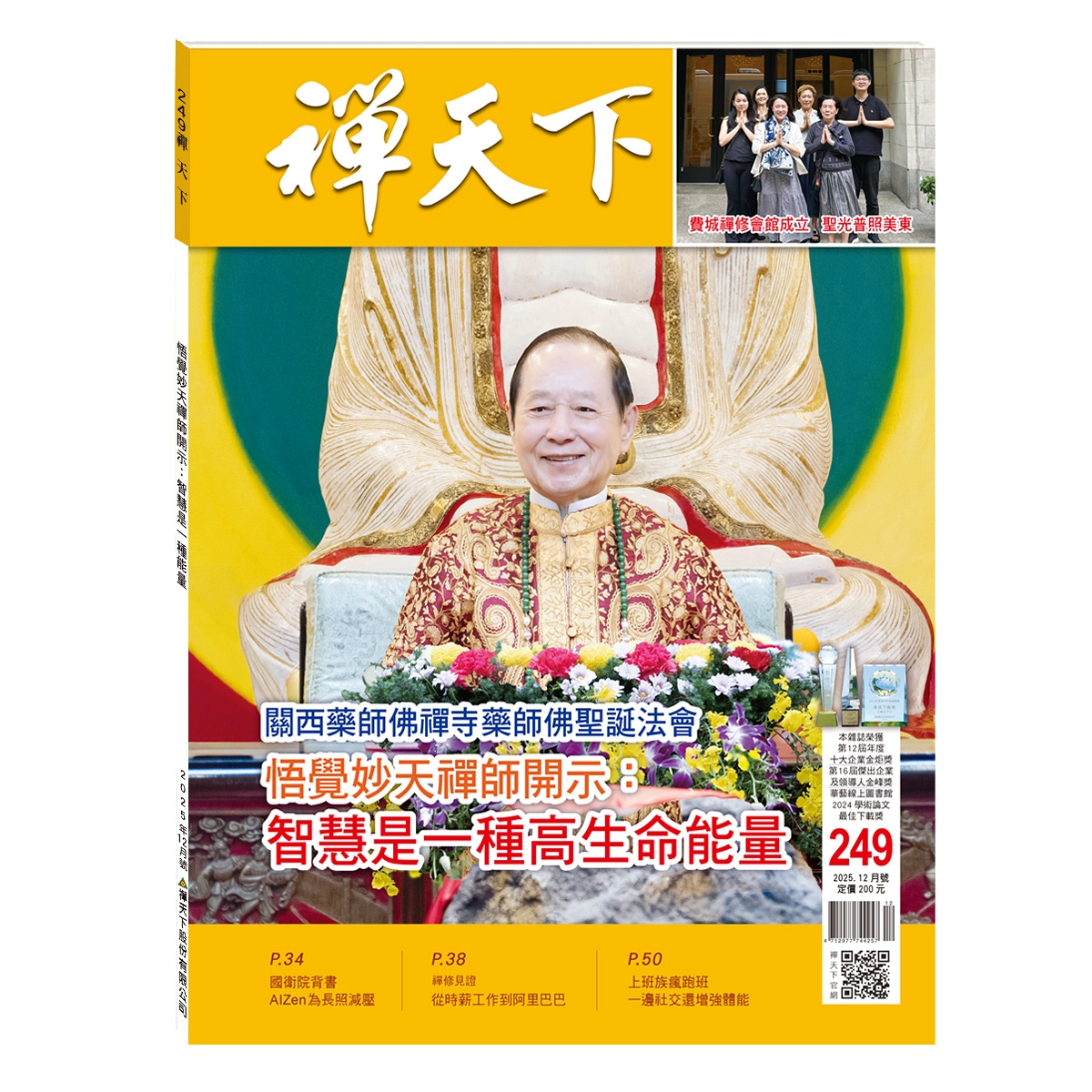
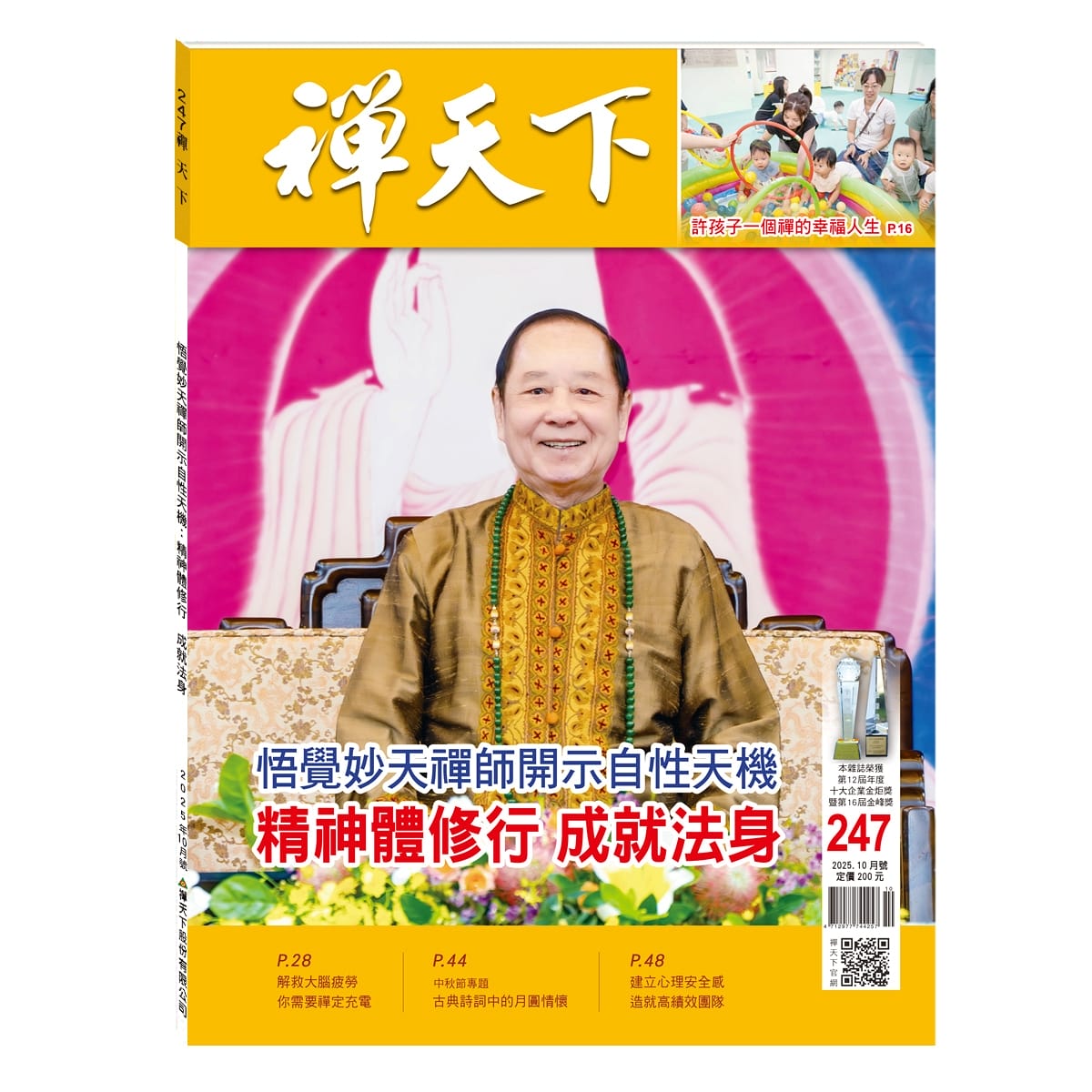
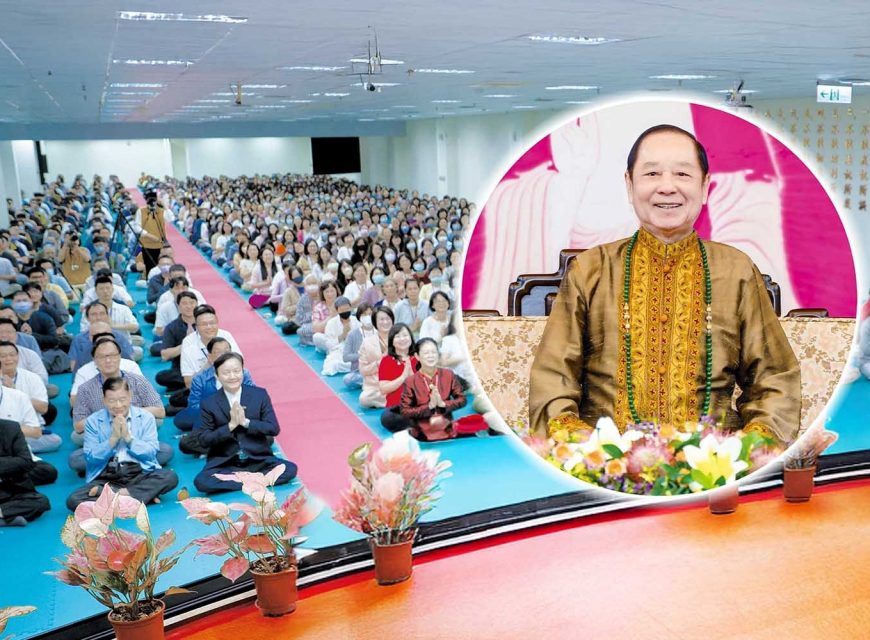
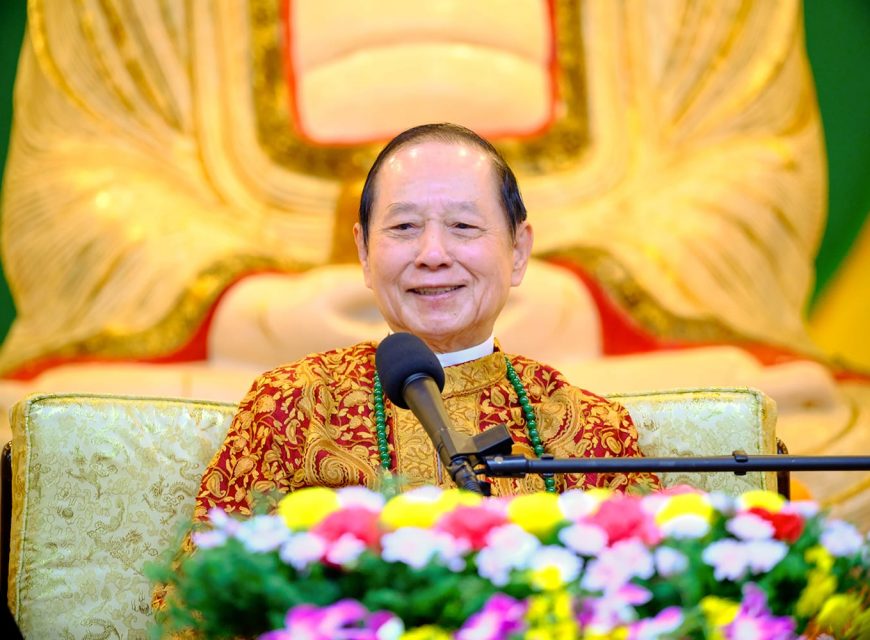
On September 6, 2025, at the Grand Zen Hall of the Shakyamuni Buddha Salvation Foundation in Nangang District, Taipei City, Zen Grandmaster Wu Chueh Miao-Tien, the 85th-generation Grandmaster of the Zen Buddhism School, gave a discourse on “The Dharma of Heart-Imprint Buddhist Zen for Attaining Buddhahood” to his disciples in Taiwan and around the world via video link. He also revealed the distinctions between Heart-Imprint Buddhist-Zen practice of Zen School and Daoist practice of Lao Tzu, passed down the methods for cultivating the spiritual body, and encouraged disciples to achieve the Dharma body and be liberated from samsara as soon as possible.
As the doors of the Nangang Grand Zen Hall opened exactly at 8 a.m., many disciples were already lined up to enter. Before the formal teaching began, all the disciples were in quiet meditation. At 10 a.m., Grandmaster Wu Chueh Miao-Tien led the disciples in respectfully reciting the “Opening Sutra Verse”:
“Commit to perfect enlightenment.
Uphold all bodhi acts.
Instantly transcend the three realms.
Manifest the Buddha body now.”
Subsequently, the Grandmaster respectively invited Shakyamuni Buddha to reside.
Grandmaster Miao-Tien’s discourse focused on three themes: “The mystery of human life,” “The distinction between Dao and Zen,” and “The practice of Heart-Imprint Buddhist Dharma and Heart-Imprint Zen Dharma.”
The Mystery of Human Life
The Grandmaster began by emphasizing the brevity of human life. To maintain health and to enlighten your heart and witness your true nature (true self, or self nature) through your practice, it is essential to understand the structure of the human body. The Grandmaster revealed that with proper cultivation, living up to 150 years old is not impossible. The human body is composed of cells that form tissues, tissues that form organs, and organs that form systems. The Grandmaster recited each organ and system, bestowing blessings upon them, and reminded his disciples not to merely listen but to synchronize and respond to each part inside the body.
“Don’t let the teaching go from the ears to the mind and then to the heart; instead, let the teaching go directly from the ears to the heart, that is, let the heart hear directly. Because my words contain the Dharma, I impart them to your hearts. This is the scheme of ‘transmitting the Buddha heart’ and ‘heart-to-heart synchronization,’ so that you can purify yourself from the inside out and gain wisdom.”
The Grandmaster explained that the health of all organ systems results from the fluent circulation of Qi and blood. Daily activities are very energy-draining. Energy comes from Qi and blood. To maintain good circulation of Qi and blood, you must first have healthy blood. Blood carries nutrients and Qi is the energy formed from these nutrients. Therefore, proper diet is the first step in nourishing your spirit.
The Grandmaster further explained that besides the normal circulation of Qi and blood, the most important factor is the “Shen” (spirit). Daoism emphasizes “Jing, Qi, Shen” (essence, energy, spirit). We use our “Shen” to direct our daily life and work. This Shen integrates the activities of the five senses and the sixth consciousness “eyes, ears, nose, tongue, body, and mind.” Since we are out and about during the day, the Shen should rest when we sleep at night.
If the Shen keeps active without sleeping, one tend to have insomnia. The Grandmaster said, “Before sleeping, you must settle all matters in your mind so that once you lie down, you can fall asleep immediately. Don’t think about things after lying down. Sometimes I do this too, but I am not thinking aimlessly. Instead, I am thinking about how you can fully receive the Dharma I transmit to you so that you can achieve enlightenment. Accordingly, my insomnia is all for your sake.” The disciples were deeply moved and, with palms together, bowed in gratitude.
The Grandmaster then taught a method to prevent insomnia. You’d better go to bed before 10 p.m. When lying down, you meditate on a notion “let the spiritual heart return to its proper place and let me sleep peacefully.” The Grandmaster explained, “The Shen must return to the heart. It should not wander back to the consciousness of the brain to think wildly.”
Daily life and work can be energy-consuming. Therefore, you must find a way to replenish Qi. The Ten-Chakra Zen Meditation of Heart-Imprint Zen Dharma, instructed by Grandmaster Wu Chueh Miao-Tien, allows for the circulation and replenishment of Qi energy at any time. “When you focus your meditation on the chakras, the resulting energy field generates the Qi energy. This is the way to replenish the life energy of your physical body. Additionally, you should pay more attention to the life energy of your spiritual life form.”
The life energy of the spiritual life form is the “spiritual body” itself. The Grandmaster explained, “Spiritual practice requires the use of the spiritual body, which is the spiritual heart entity within your heart. The spiritual body is your instinct, your original life.” This spirit is the “Shen” used in our daily activities. The Shen becomes exhausted because it always commands activities outward. Accordingly, your heart must quiet down during Zen meditation. That is, “Let the heart return to its proper place, and then enter Zen meditation.”
In preparation for entering Zen meditation, one must achieve “one heart, three emptinesses.” The term of “three emptinesses” stands for the emptiness of body, emptiness of mind, and emptiness of heart. The Grandmaster recounted that this is because the first step in meditation is to attain purity. The senses of “eyes, ears, nose, tongue, body, and mind” (the five senses and the sixth consciousness) in most people will enter the heart. These five senses and the sixth consciousness, along with the Manas (seventh) and Alaya (eighth) consciousnesses, constitute the eight consciousnesses. These eight consciousnesses are the factors causing impurity.
Many practitioners cultivate the eight consciousnesses to achieve purity. Nonetheless, the Heart-Imprint Buddhist Zen guides your practice directly into the heart. The Grandmaster directly instructs His disciples to cultivate “Purity, Wisdom, Perfection, and Accomplishment of Buddhahood.” According to the Grandmaster’s teaching, purity means purifying the eight consciousnesses because the eight consciousnesses ultimately return to the heart. Thus all impurity resides within the heart. Purity means turning to right mindfulness from the very beginning. Do not let negative energy get into your consciousness and then into your heart.
The Grandmaster explained that vegetarianism, chanting sutras, repentance rituals, worshipping Buddha, and reading Buddhist scriptures are not the Buddha Dharma itself but merely auxiliary practices to help one return to purity. The Grandmaster taught, “True purity is the ‘Precepts’ in the Buddha’s ‘Three Trainings’ of ‘Precepts, Dhyana (Zen meditation), and Wisdom.’ You must cultivate purity, and this cultivation must be done with your spiritual body.”
The Ten-Chakra Zen Meditation of Heart-Imprint Zen Dharma transmitted by the Grandmaster can be practiced to circulate and replenish Qi and accordingly to restore the consumed energy. Qi is the invisible spirit, while blood is the visible substance. Qi and blood are inseparable. Qi cultivation aims to energize the Qi (the spirit) in your heart. Only with a strong spirit can one complete work and face challenges. When the body and mind are relaxed and happy, everything goes smoothly. Conversely, stress and unhappiness can generate many negative thoughts, leading to impurity of the eight consciousnesses.
The Grandmaster pointed out that traditional spirit cultivation only focuses on nourishing Qi and blood, neglecting the truly important aspect of spirit. This spirit is our inherent life, residing within the heart. “Qi, blood, and Shen (spirit)” must be a trinity, and all of them must be in excellent health. Therefore, besides good lifestyle habits, you must be careful to prevent negative thoughts from reaching the heart and filling the heart with negative energy.
The Distinction Between “Dao” and “Zen”
Lao Tzu’s Dao De Jing states, “The Dao that can be spoken of is not the eternal Dao.” The Dao advocated by Daoism is an extraordinary Dao, invisible but governed by laws. It also says, “The term that can be called is not the eternal term.” The term that Daoism refers to is not the term we generally know. Dao De Jing further addresses, “The unity of Yin and Yang is called the Dao, and the Dao gives birth to all things.” Grandmaster Miao-Tien considered this explanation not yet complete.
The Grandmaster said, since it can give birth to all things, this Dao is the Dao (way) of life. How does it give birth to all things? The phrase “The Dao gives birth to all things” is missing a crucial element, the kinetic energy. It should go through some process so that the Dao can give birth to all things. Therefore, the Grandmaster believed that “the unity of Yin and Yang is called the Dao, and the Dao ‘operates’ to give birth to all things.”
The Grandmaster gave an example: Why don’t planets fall down in the universe? It is because the Qi within them continuously operates and strengthens itself. “The statement ’The Dao gives birth to all things’ only addresses the material body, neglecting the spiritual body. It only observes the life of matter without recognizing the life of spirit. The energy of Qi is also the life of spirit. Zen, however, considers both spirit and matter. The entire universe is the existence of spirit and matter, and through transformation, life emerges, giving rise to all things.”
Therefore, the Grandmaster defined “Zen” as: “The universe contains the life energy of material life forms and the life energy of spiritual life forms. The merging of these two into one, through some operation, transforms into different forms and phenomena. This is called Zen.”
“The Dao only involves birth and death, the cycle of life and death, but the spiritual body can live forever. The Heart-Imprint Buddhist Zen transmitted by Shifu (Grandmaster Wu Chueh Miao-Tien), including both Buddha Dharma and Zen practices, can improve physical health and prolong life, and also bring happiness and joy to your heart.”
How does Zen operate and transform? The Grandmaster cited examples of animals, plants, minerals, and other living beings in the universe or on Earth. According to Daoism, living beings can naturally thrive. “But what I’m talking about is a kind of operational transformation. This phenomenon of operational transformation is Zen. The energy of material life forms and the energy of spiritual life forms in the entire universe merge together and operate. This phenomenon is called Zen.”
“Zen transforms the material life into nothingness, which is the cycle of birth and death. Zen transforms the spiritual life into endless life and continuous self-strengthening, which is immortality.”
The Zen Grandmaster instructed that cultivation should transition from the “material” level to the “spiritual” level. Nevertheless, nowadays practitioners often overlook the cultivation of the spiritual body. The Heart-Imprint Buddhist Zen imparted by the Grandmaster requires the use of the spiritual body, and it is the spiritual body that is cultivated. How to cultivate it? It is to purify and cultivate wisdom in our spiritual life form (spiritual body).
Looking at current practices, many do not even recognize the existence of the spiritual body, let alone cultivate through the spiritual body. Instead, they focus solely on reciting scriptures, worshiping Buddha, and reading Buddhist texts, which are actually of no use because they are not cultivating the spiritual body. They are just spinning around in their consciousness.
The commonly accepted definition of Buddhism is “Do no evil, practice all good, purify one’s mind; this is the teaching of the Buddhism.” The Zen Grandmaster believes that this definition is limited to “purifying one’s mind,” which only reaches the sixth consciousness, failing to access the true essence of the heart. If the seventh and eighth consciousnesses are not purified, and there is no wisdom, how can one attain Buddhahood? Becoming a Buddha is the true meaning of Buddhism. Therefore, the Grandmaster revised “purifying one’s mind” to “purifying the original mind,” and added “complete realization of Bodhi,” transforming it into (the opening verse) “Do no evil, practice all good, purify the mind, and attain Buddhahood,” which is the true significance of Buddhism.
The Grandmaster compassionately explained that due to a lack of spiritual cultivation in the human world, people only emphasize the material development and the intellectual cultivation. Thus, when faced with unpleasant experiences, they can only endure and accumulate these feelings in their hearts, eventually getting into the subconscious. As one ages, the accumulated impurities grow, making individuals more stubborn. This is all because the spiritual body has not been cultivated. So it is essential to promote the spiritual cultivation of the Heart-Imprint Buddhist Zen.
The Grandmaster pointed out that “ordinary Dao at most involves practicing energy work to maintain material life, without understanding the spiritual aspect, such as how to achieve a pure heart and attain higher wisdom of life. Ordinary Dao does not cultivate these aspects. Generally, monks and lay practitioners are the same. If they do not cultivate the spiritual body, how can they attain enlightenment?”
The Grandmaster taught that the Ten-Chakras Zen meditation of Heart-Imprint Zen Dharma simultaneously purifies and connects to all ten realms: “Hell, Hungry Ghosts, Animals, Asuras, Humans, Devas, Arhats, Pratyekabuddhas, Bodhisattvas, and Buddhas.” When the physical body is gone, the spiritual body does not die. Where it goes is entirely up to oneself, depending on the purity of the subconscious. It is not God who judges us.
“If the eight consciousnesses are not purified, one will enter an impure realm. If the eight consciousnesses are purified, one will enter a pure realm. The pure realm is the Bodhisattva realm, and the wisdom realm is the Buddha realm. Therefore, spiritual practice must have a goal; otherwise, no matter how much you practice, it will be useless. This goal is to cultivate both the material life entity and the spiritual life entity to achieve purity and then enter the realm of wisdom through Zen meditation.”
The Grandmaster emphasized that true practice occurs only after the eight consciousnesses are purified, so one must start from the purification of the heart entity and then progress to cultivation of wisdom. Cultivation is not done by “the person”. Since one aims to purify, cultivate wisdom, achieve perfection, and become a Buddha, it is not just the physical body that needs cultivation, but also the spiritual body.
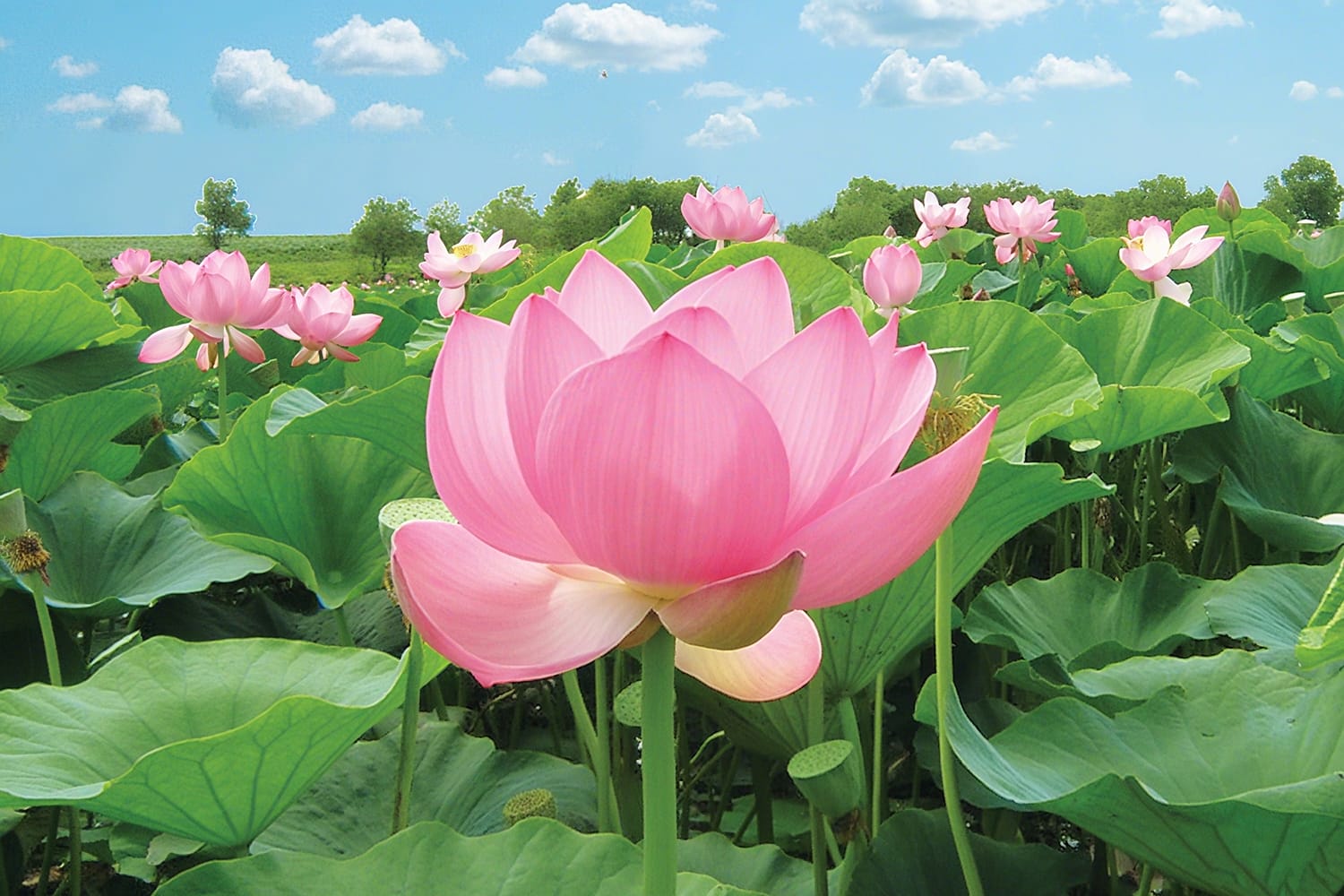
Our true nature is the spiritual body, which is the primordial spirit (Yuan Shen). The primordial spirit is inherently pure and luminous. Spiritual cultivation is about maintaining the purity and wisdom of the primordial spirit, and ultimately achieving the Dharma body.
The Practice of Heart-Imprint Buddhist Dharma and Heart-Imprint Zen Dharma
How to practice Heart-Imprint Buddhism Dharma and Heart-Imprint Zen Dharma? Grandmaster Miao-Tien explained that both of these practices focus on ourselves. The key lies in how to cultivate the life energy of the material body and the life energy of the spiritual body.
“Heart-Imprint Buddhist Dharma cultivates the purity and wisdom of the spiritual body, ultimately connecting to the highest wisdom of the supreme life.”
“Heart-Imprint Zen Dharma cultivates the ‘Qi, blood, and Shen (spirit)’ of the material body, promoting health and longevity. Ultimately, the material body will merge with the spiritual body and achieve enlightenment.”
The Grandmaster stated that this is how cultivation is done, but no one knows. The Grandmaster explained the details clearly, allowing everyone to gain insight and clarity.
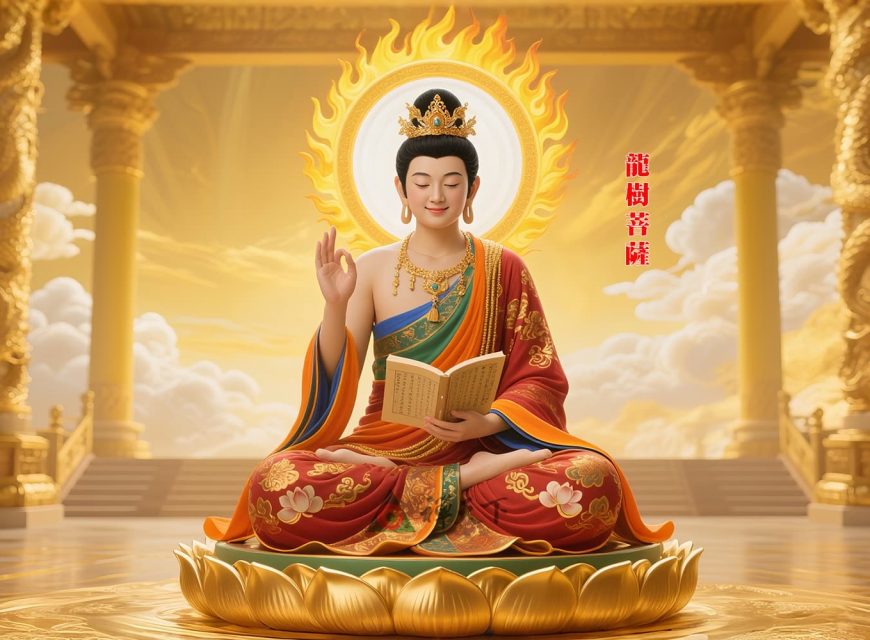
The Grandmaster then explained the Eight Consciousness Theory of Nagarjuna Bodhisattva, quoting the verses of ancient monks as a metaphor: “Eight brothers from the same womb; one is clever, one is dull; five are out doing business, one stays inside keeping the accounts.”
Which five are out doing business? These are our five senses “eyes, ears, nose, tongue, and body” that come into contact with outside world and transmit all the information received back to the consciousness, recording everything.
The (sixth) consciousness is the “mind” of “eyes, ears, nose, tongue, body, and mind.” It is responsible for managing accounts, recording everything transmitted back from the five senses, and reporting to the boss, which is the heart.
Why is the heart described as “one clever, one dull”? The Grandmaster clarified that the dull aspect is the subconscious, which stores all these records, good or bad, and accepts them all. The clever aspect is the human heart, the worldly heart, filled with ego. The subconscious reflects the attachment to phenomena. The seventh consciousness is the Manas consciousness, that is, the subconscious. And the eighth consciousness, Alaya, is the heart consciousness (consciousness of the heart).
The Grandmaster further explained that after the eight consciousnesses, there is a ninth consciousness. “But the ninth is not consciousness; it is wisdom, Amala wisdom. It should not be translated as Amala consciousness because Amala wisdom is pure. When the heart becomes pure, it returns to the purity of its original heart, which is one’s true nature, inherently pure. The tenth is wisdom, the wisdom of the Tathagatagarbha. Therefore, it should not be translated as Tathagatagarbha consciousness.”
After discussing the eight consciousnesses, the ninth wisdom, and the tenth wisdom, Grandmaster Miao-Tien added two sentences: “A fragrant scent wafts in; seeing Manjushri Bodhisattva seated on a lotus throne,” to the original metaphor “Eight brothers from the same womb; one is clever, one is dull; five are out doing business, one stays inside keeping the accounts.”
The Grandmaster explained that the fragrance signifies purity, which corresponds to the ninth Amala wisdom. Upon smelling the fragrance and taking a look, it turns out to be Manjushri Bodhisattva sitting on a lotus throne, representing the tenth Tathagata wisdom. Here Manjushri Bodhisattva symbolizes wisdom.
The purification of the eight consciousnesses also aligns with the “Ten Dharma Seals of Zen” imparted by Grandmaster Miao-Tien. The Grandmaster stated that this is the plain language version of cultivating the eight consciousnesses plus two wisdoms. The first to the eighth correspond to the purification of the eight consciousnesses. The ninth coincides with the wisdom of purity. The tenth is the grand wisdom of the supreme life with the highest wisdom, which is the wisdom of the entire universe. This wisdom can be attained through the practice of Heart-Imprint Buddhist Zen.
(Note) The Ten Dharma Seals of Zen:
1.Not being misled by self attachment.
2.Not being confused by form attachment.
3.Not being deluded by fame and fortune.
4.Not being tormented by material desires.
5.Not being swayed by illusions.
6.Not being angered by evil forces.
7.Not being trapped by infatuation.
8.Not being disturbed by worldly affairs.
9.Having a bright and upright heart.
10.Possessing vast and boundless wisdom.
Zen Grandmaster Wu Chueh Miao-Tien has been preaching since 1983, and as of 2025, it has been the 43rd year. The various teachings during this period have all aimed to guide disciples in achieving purity. The Grandmaster stated, “Whether practicing general Buddhist teachings or Heart-Imprint Buddhist Zen, the most important thing is that the eight consciousnesses should not contaminate the heart. When the heart is pure and free of dark clouds, spiritual practice becomes easier. If there are still dark clouds covering your heart, it will be very difficult to cultivate.”
The Grandmaster then clarified further that, it is generally believed that Maitreya Buddha will appear after 5.67 billion years. However, the Grandmaster stated: “Those ‘5.67 billion years’ refer to the five senses, the sixth consciousness, and the seventh consciousness. And Maitreya Buddha should be replaced with Manjushri Bodhisattva since the starting point of wisdom should be when one sees Manjushri Bodhisattva.”
The Grandmaster earnestly urged his disciples that, in addition to practicing the ten chakras for physical health, they must continually cultivate a pure heart and then cultivate wisdom. “Although it is said to cultivate purity, your true nature is inherently pure. The phrase ‘Your true nature is inherently pure’ refers to your Shen, your original life form, your spiritual body, which is pure, not your physical body. Cultivation is about cultivating the spiritual body and maintaining the purity and wisdom of that original life form.”
Finally, the Grandmaster revealed the heavenly secret, which is the most important core essence of this lesson: “This true-nature entity, this spiritual body, is your primordial spirit (Yuan Shen), the original life form. The primordial spirit is inside, together with your body and mind. Because you are contaminated by the eight consciousnesses, your primordial spirit is surrounded by dark clouds. Lighting the Lamp of The Yuan Shen is to dispel the dark clouds, and thereafter restore purity and light.”
The Grandmaster once again emphasized that many people do not know what to cultivate in their Buddhist practice. It is to keep the inner primordial spirit constantly pure and to raise the wisdom energy of the primordial spirit higher and higher. Wisdom energy is the life energy of the highest level of wisdom in the universe. When you are able to completely purify yourself, when your meditation enters the level of wisdom, the wisdom of the Tathagata will come in, gradually grow, and then become a spiritual body, and finally become the Dharma nature, and the Dharma body.
Grandmaster Wu Chueh Miao-Tien’s auspicious Dharma assembly for humans and celestial beings concluded at 11:30 a.m. All attending disciples from both Taiwan and abroad gained insight into the importance of the spiritual body and understood how to practice Heart-Imprint Buddhist Zen. After a morning of being bathed in Buddha light, everyone felt rejuvenated in body, mind and heart.
English Translation: Chueh Miao Dao-Lian and Chueh Miao Gong-Ming
看下一篇文章