

Question: Is there a division of stages in Zen practice?
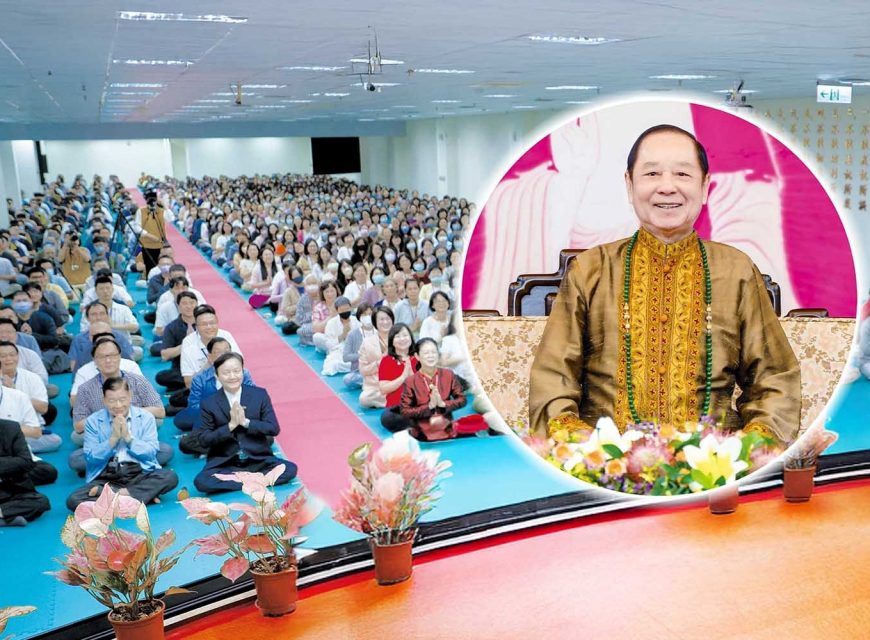
Narration by: Grandmaster Wu Chueh Miao-Tien, the 85th-generation Zen Grandmaster of the Zen School
The first stage of Zen practice requires concentration, and the requirement for concentration lies in the unity of the spirit. During Zen meditation, you should empty the mind and think of nothing. After practicing in this way for some time, your heart will become completely empty, and your consciousness will devoid of anything. If you can maintain this state, no matter what others say, you will understand their true thoughts and know what they like and dislike. This is the ability of “mind perception.”
This ability of “mind perception” does not need to be pursued intentionally; it is a manifestation that arises naturally in Zen meditation. Many people intentionally pursue supernatural powers. In fact, if you pursue something intentionally, you will not attain it because the intention to pursue covers up the power of the supernatural. Therefore, true supernatural ability is gained naturally without seeking. You will gain nothing by intentionally seeking it.
In addition to having concentration, you must also keep the mind still and avoid delusive thoughts. At first, this is difficult. The more you try to eliminate thoughts, the more delusive thoughts tend to arise. This is something that commonly happens to the beginners. Nevertheless, after some time, delusive thoughts will gradually decrease until they are as still as the body is (both your body and mind are still). Then at this time, the brain will not consume energy, but will instead be replenished. When both the body and the mind reach stillness, that is the moment of body-mind balance.
The essence of Zen consists of balance and unity (Note). This balance and unity can be applied not only in spiritual practice but also in various aspects of life and work. Hence, the second stage of Zen practice involves the transition from physical obstacles to psychological obstacles, where psychological obstacles refer to the obstacles of the mind, aiming for a balance between body and mind.
(Note) The Seven Great Essences of Zen: Transcendence, Equality, Balance, Unity, Nature, Great Freedom, and Great Perfection.
The third stage is entering into emptiness. When the body and mind are balanced, one enters emptiness. Upon entering the state of emptiness, one will find that the body and mind are free of burdens and worries, experiencing profound joy, and inspiration will continuously arise. In this state of emptiness, if one gets into deeper Zen meditation, another world will emerge. Besides the world of forms and appearance that we see with our eyes and hear with our ears, a spiritual world will manifest.
In religious terms, this spiritual world is the world of ultimate reality. The world of humans is an illusory world because it is subject to birth and death, while the spiritual world is eternal and unchanging. In fact, we are born with our spirituality; it is our soul entity, which is neither born nor dies, neither arising nor ceasing.
Many people may ask, “Can I have more wealth? Can I be promoted and prosper?” In truth, to be promoted and prosper, certain conditions must be met. Your spirituality must be elevated to a significant level, and you must have a considerable degree of blessings or merits. So how do you elevate your spirituality? It is through Zen cultivation, specifically the practice of Heart-Imprint Zen Dharma and Heart-Imprint Buddhist Dharma. This will raise your spirituality and bring you immense good fortune and blessings.
Translation: Chueh Miao Dao-Lian, Chueh Miao Gong-Ming