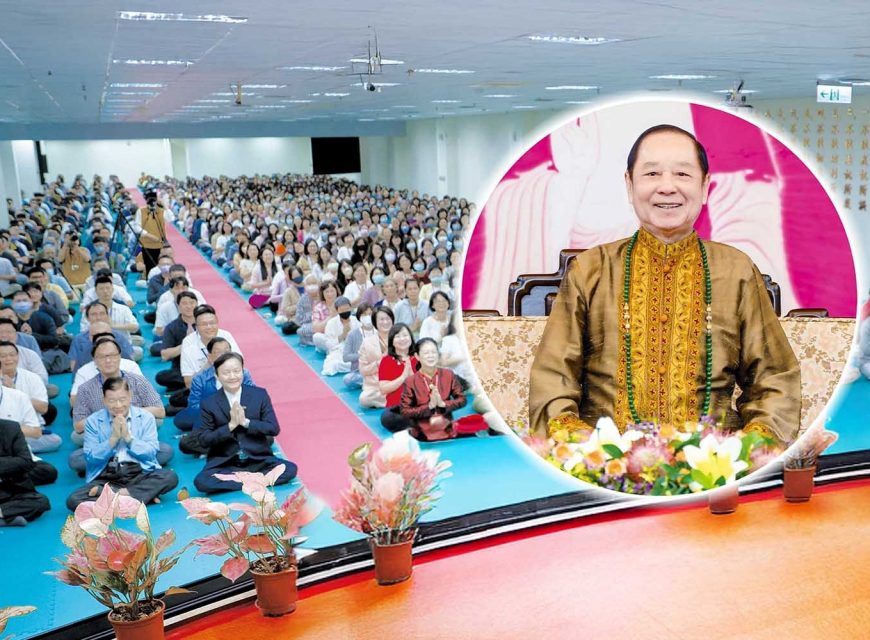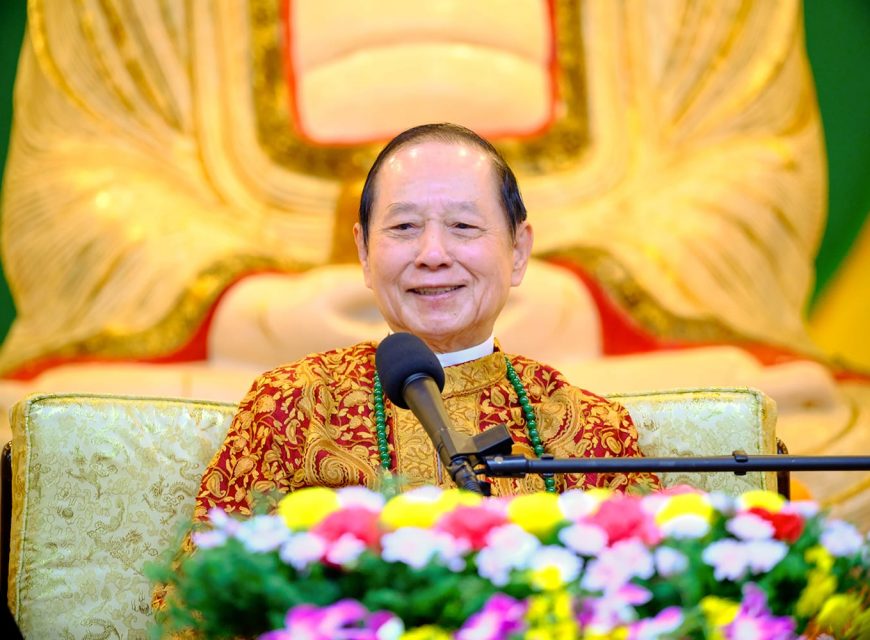


Lecture by: Zen Grandmaster Wu Chueh Miao-Tien, the 85th-generation Grandmaster of the Zen School
(This article is excerpted from the “Heart-Imprint Buddhist Dharma Intensive Lectures”)
The purpose of practicing Buddhism is to witness one’s true nature (true self or self nature) and attain Buddhahood. If it is not for the purpose of witnessing one’s true nature and attaining Buddhahood, then no practice is of any benefit. Therefore, one should not remain focused on the practice of the mind or the five senses, thinking that cultivation merely involves reading Buddhist scriptures, listening to Dharma talks, or intellectual contemplation, etc.
Heart-Imprint Buddhist Dharma represents the ultimate and most authentic Buddhist Dharma. It is very easy to practice as long as you resonate with it; there is no need to take notes. Resonance means listening attentively with your heart, feeling deeply with your heart, and sensing with your heart. If you can respond in this way, you can quickly keep up with Shifu (the Grandmaster). Otherwise, relying on intellectual thinking will cause many problems. These hindrances are created by your lack of knowledge.
For example, someone asked: “Our heart should not be bound by external things, but the Ten Chakras Meditation of the Heart-Imprint Zen Dharma transmitted by Shifu requires focusing the heart on the chakras. Wouldn’t this cause the heart to become attached to the form?”
This question reveals that the person asking it doesn’t understand what attachment to the form is. What forms can bind the heart? For instance, when a man and woman fall in love and then separate, they feel heartbroken and sad. This is because their hearts are tied up. Therefore, the heart should be free from attachment to forms.
Focusing on the Ten Chakras; Purifies the Ten Dharma Realms
The Diamond Sutra says that the heart should not be bound to “people, places, events, or things,” and should not be attached to forms, including all things and phenomena in the universe. If the heart becomes attached to forms, it will feel uneasy. However, focusing is not about being attached to forms. The purpose of focusing on the chakras is to purify them, not to be attached to forms, because once you enter the chakras and enter samadhi, it is no longer about forms.
On the surface, chakras appear as forms, but what I transmit is not about clinging to the forms of “chakras,” but rather about purifying the chakras, generating an energy field from within, allowing oneself to enter that Dharma realm, and then purifying that Dharma realm. Therefore, it is not about clinging to forms. In practice, don’t get bogged down in details; simply respond to the Dharmas transmitted by Shifu. If you indulge in random thoughts, you will only create hindrances for yourself.
The same applies to reading Buddhist scriptures. Many people are hindered by superficial words because they do not grasp the true meaning and thus develop doubts. The Diamond Sutra states: “The heart should abide nowhere in form.” One must be unattached to forms to generate the heart, that is the original heart. If one is always attached to forms, the original heart is obscured, and the true nature cannot manifest.
When I was practicing Buddhism more than 40 years ago, I learned that I should use wisdom to read Buddhist scriptures so that I could truly understand the truth of the scriptures. At that time, I greatly admired Ksitigarbha (Earth-Treasury) Bodhisattva’s vow: “Until hell is empty, I vow not to become a Buddha; until all sentient beings are saved, I vow to attain Bodhi.” Generally, people think hell is a place for the most evil beings. Is it possible to empty hell? Impossible! So does that mean Kṣitigarbha Bodhisattva cannot become a Buddha?
In fact, Kṣitigarbha Bodhisattva has already become a Buddha, known as the Formless Buddha. Because people believe hell can never be emptied, they interpret this scripture to suggest that Kṣitigarbha Bodhisattva manages the hell. This is a concept arising from human intellectual thinking.
The hell Kṣitigarbha Bodhisattva refers to is the hell of agony within our own hearts. When the heart is free from afflictions and agony and feels comfortable, blissful, and peaceful; the hell is empty as such.
When the hell of afflictions in the heart is emptied, all other hindrances are purified, and naturally one can become a Buddha. Therefore, the common understanding that hell refers to an external hell is incorrect. The hell of the Ten Dharma Realms refers to our heart. If the heart feels peaceful, blissful, and blessed, that is heaven; if it feels painful and afflicted, that is hell.
Kṣitigarbha Bodhisattva also said: “Until all sentient beings are saved, I vow to attain Bodhi.” But there are countless sentient beings—how can they all be saved? Accordingly, Kṣitigarbha Bodhisattva would not have attained Buddhahood. This is the common understanding.
Actually, the sentient beings are not external beings but the sentient beings within ourselves. Cultivating according to the Heart-Imprint Zen Dharma transmitted by Shifu, when both body and heart are purified, all can be saved.
When the Heart is Pure, Hell is Empty; Liberate Sentient Beings from Karma
Someone asked me: “When focusing on the chakras, if you simply let go, does that mean you have achieved complete emptiness and no hindrances?” No, this emptiness is not perfect emptiness, but rather a stubborn emptiness.
Perfect emptiness is complete emptiness. For example, finishing and doing things well is a form of emptiness. Or, for instance, if you owe someone money and keep running away from it, will you achieve emptiness? No, you must pay it back before you can achieve emptiness.
Similarly, we must eliminate and purify the hindrances in our body and mind in order to attain true emptiness; This is wise spiritual practice.
What is samsara? For example, the sun rises in the east every morning and sets in the west every evening, day after day, in a cycle—that is samsara. Humans and all sentient beings are the same; they are born and die, die and are born again—this is also samsara. Our bodies are the same.
Since all things on Earth are subject to samsara, our lives are naturally also subject to samsara. Therefore, the purpose of Buddhism practice is to transcend samsara altogether, to avoid being reborn after death. If one is subject to birth and death, that is samsara; if one is no longer reborn, that is liberation, also known as Nirvana.
We want our spirit to live forever in the Buddha realm to completely liberate ourselves from samsara. This is the purpose of our Buddhism practice. However, liberation from samsara cannot be achieved by merely reading or reciting scriptures. One must enter deep meditation to allow body and mind transcend the Earthly Dharma realm to transcend samsara. Only through this method of practice can we directly benefit our spirits.
Our spirit has been trapped in samsara for countless asankhyeya kalpas (inconceivably long period of time). If we truly want to escape samsara, we must witness one’s true nature, and then continue diligent cultivation. Witnessing one’s true nature occurs only after reaching the second great asankhyeya kalpa, while becoming a Buddha requires transcending three great asankhyeya kalpas.
The first great asamkhya kalpa is the stage of accumulation. One must accumulate a lot of merits, uphold many precepts, and refrain from creating negative karmas, so that the spirit is filled with the conditions for accomplishment, in order to transcend the first great asamkhya kalpa.
In addition, one must cultivate the preliminary practices, perform meritorious deeds, and practice the Six Paramitas (Six Perfections). None of these can be omitted in order to transcend the second great asamkhya kalpa and reach the seventh Bodhisattva Ground (see note).
(Note) The Ten Bodhisattva Grounds:
1st Ground: Joyful Bodhisattva
2nd Ground: Spotless Bodhisattva
3rd Ground: Radiant Bodhisattva
4th Ground: Blazing Wisdom Bodhisattva
5th Ground: Unconquerable Bodhisattva
6th Ground: Manifest Bodhisattva
7th Ground: Far-Going Bodhisattva
8th Ground: Unshakable Bodhisattva
9th Ground: Good Wisdom Bodhisattva
10th Ground: Dharma Cloud Bodhisattva
Witnessing one’s true nature corresponds to the sixth Bodhisattva Ground, so “witnessing one’s true nature” has not yet become a Buddha. Although it is commonly said “enlighten the heart, witness one’s true nature, become a Buddha,” this does not mean that enlightenment of the heart immediately leads to witnessing one’s true nature. In addition, witnessing one’s true nature does not guarantee to become a Buddha.
The third great asamkhya kalpa begins from the seventh Bodhisattva Ground. This shows that practice has stages. Only after reaching the third great asamkhya kalpa does one become a tenth-Ground Bodhisattva. However, even after completing the tenth-Ground Bodhisattva practice, one is not yet a Buddha. One must surpass the three great asamkhya kalpas to become the Wonderful Enlightened One, the Wonderful Buddha—that is true Buddhahood.
English translation: Chueh Miao Gong-Ming and Chueh Miao Dao-Lian