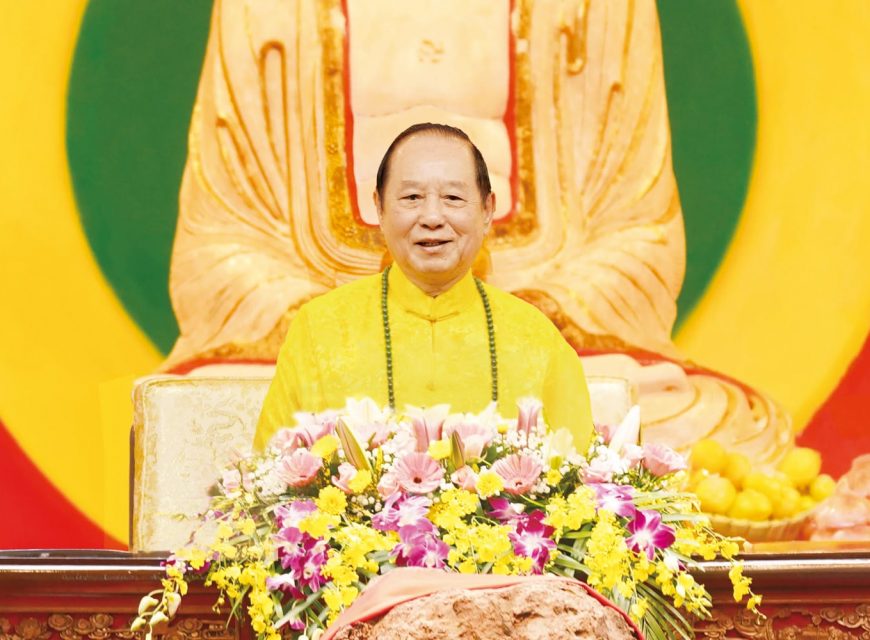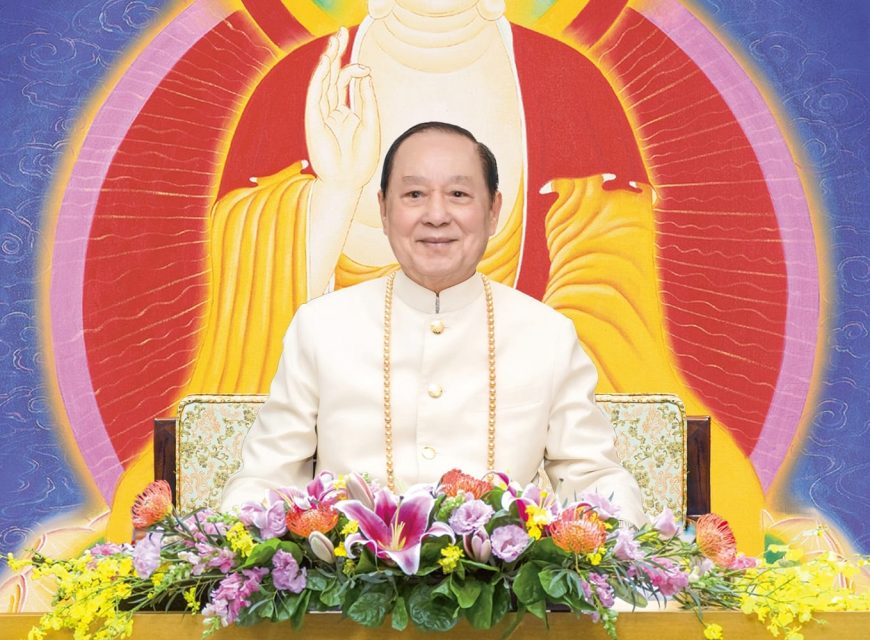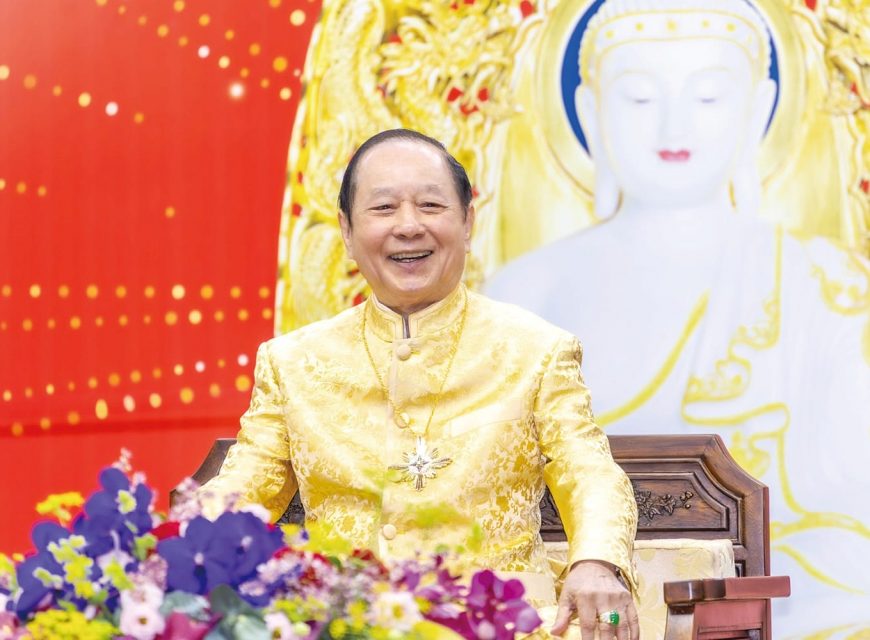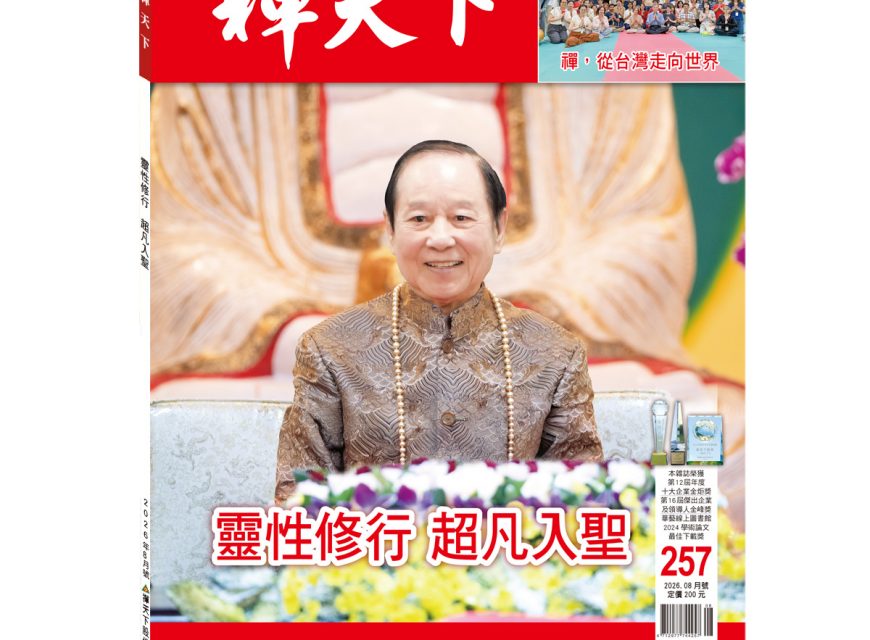

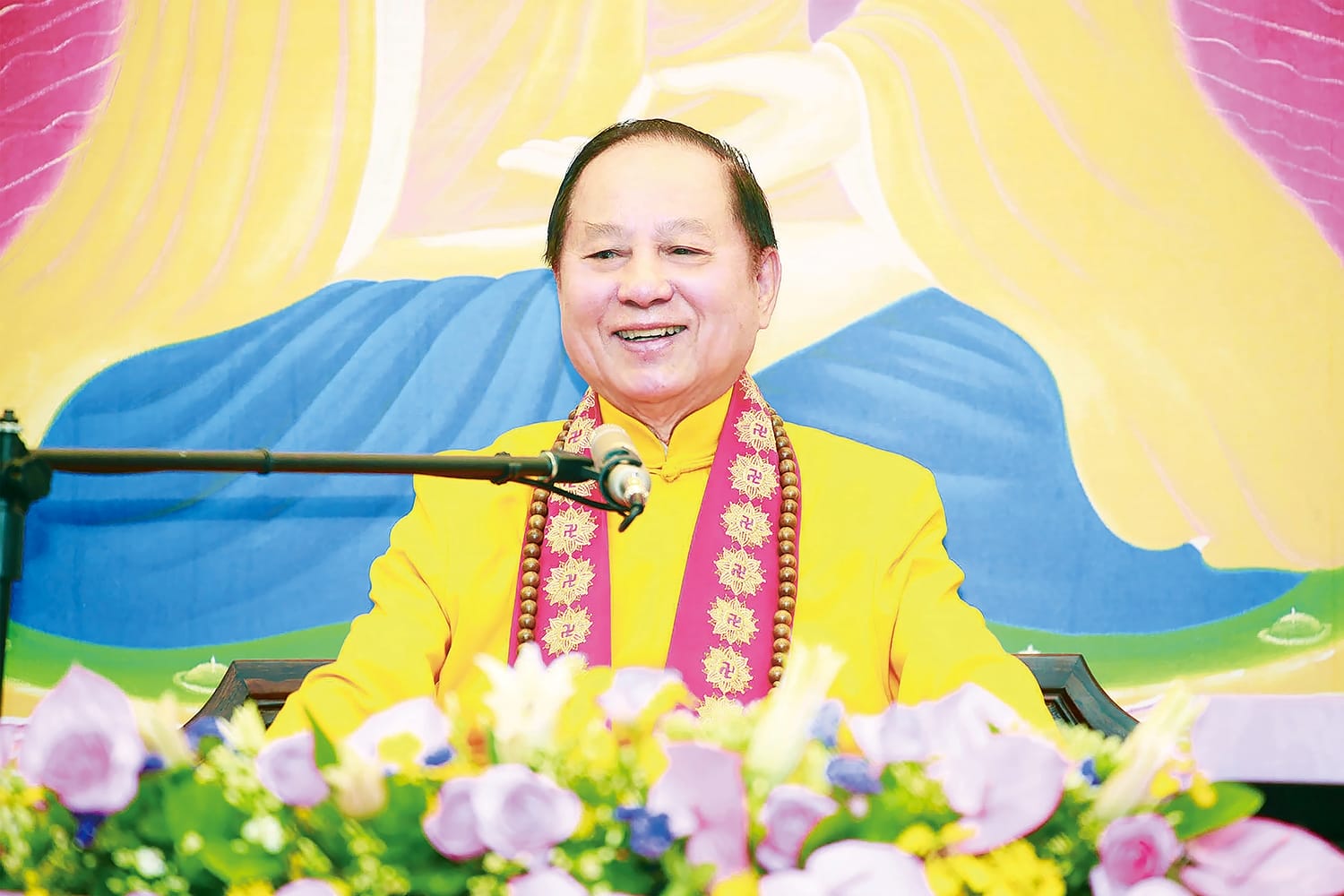
Impartation: Grandmaster Wu Chueh Miao-Tien, the 85th-Generation Grandmaster of Buddhist Zen School
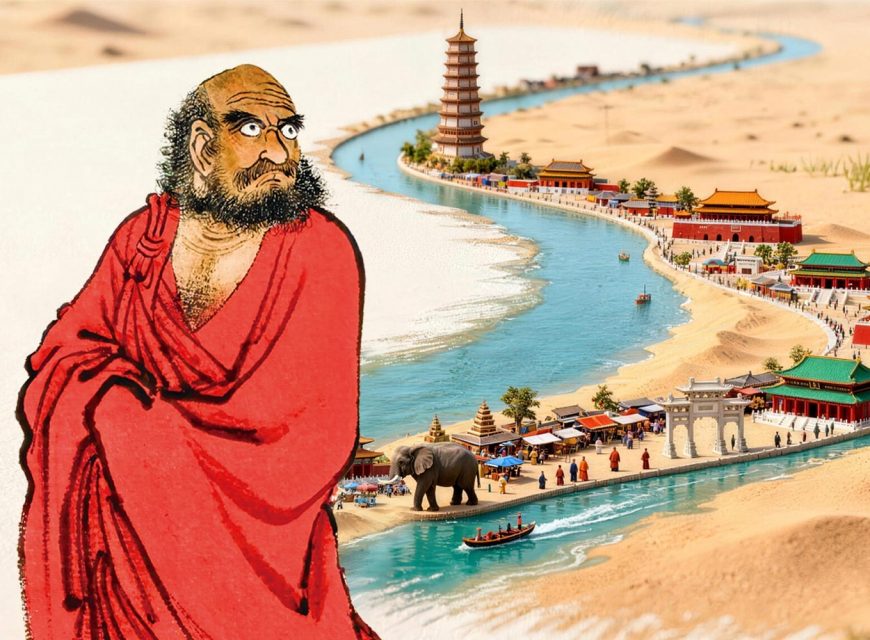
Zen Buddhism began to flourish in China only after Grandmaster Bodhidharma brought the Heart-Imprint Buddhist Dharma to the East. It reached its zenith under Grandmaster Huineng, the Sixth-Generation Grandmaster of the Chinese Zen School (the 33rd of the Buddhist Zen School),. However, following the Sixth Grandmaster, one rarely hears mention of a Seventh or Eighth Grandmaster. This is because the transmission of Zen is “from heart to heart”—it does not reside in external forms or titles. To fixate on such appearances is to fall into delusional thoughts and wrong views.
The Dharma of Grandmaster Bodhidharma is the Dharma of Avalokiteśvara (the Dharma of The Sovereign Lord, or Guan Zizai). It involves observing that the ultimate reality of all phenomena (form) is emptiness. This is what the Heart Sutra means by, “Form does not differ from emptiness; emptiness does not differ from form. Form is emptiness; emptiness is form.” If you perceive “form as being different from emptiness,” you are trapped in dualism—a state where “form is not emptiness and emptiness is not form.” That is relative dharma, not the One True Dharma (Unique Ultimate Truth), and it leads to the creation of heavens and hells.
If you can perceive that “form does not differ from emptiness, and emptiness does not differ from form,” or “form is emptiness, and emptiness is form,” it signifies that your heart is the Original True Heart and that forms, time, and space belong to the Buddha nature. Past, present, and future all dwell within this Buddha nature. Although you may have achieved Buddhahood in the past, you have returned to this Sahā world out of a great vow, taking on a physical body and a human mind. While you possess the same physical form as other sentient beings, if your body and heart are not different from the Buddha’s body and Buddha’s heart, then you are a Buddha. If they do differ, you remain a human, bound by human forms and the human mind. This requires a self-awakening.
Selflessness and Altruism; Universal Equality
The Dharma of Grandmaster Bodhidharma is about enlightenment, and enlightenment is wisdom. This Dharma is beyond learning and non-action; it is the Heart-Imprint Zen Dharma. It does not require high academic degrees or an impressive resume—it only requires awakening.
Awakening is Great Wisdom. Only those who are enlightened can remain unattached to forms. Only then can “form be emptiness and emptiness be form,” and “phenomena be principle and principle be phenomena.” When principle and phenomena are one, they are harmonious and integrated. When the human heart and the Buddha heart, as well as the body and the heart, are unified, you achieve a state of balance and equality. This is the Dharma of the Grandmaster Bodhidharma and the Dharma of the World-Honored One, without exception.
Grandmaster Bodhidharma and all enlightened masters transmitted the Supreme Bodhi Dharma. Grandmaster Bodhidharma taught that He did not favor the Dharma of the Two Vehicles (Sravakas and Pratyekabuddhas), as these Small-Vehicle (Hinayana) paths focus only on self-cultivation, still clinging to the physical body and the concept of “self.”
Grandmaster Bodhidharma’s Dharma is “No-Self.” It is altruistic, treats all as equal, and practices the Great Compassion of Oneness (Same-Body Compassion). If there is a “self,” one deviates from Buddha-nature, leading to deviant views and afflictions. But if there is “no-self,” there is no-mind. With no-mind, there are no delusional thoughts. No-delusion is purity; purity leads to sovereignty (true freedom); and sovereignty brings Great Wisdom.
This Great Wisdom is the perfection of worldly affairs and the Perfect Enlightenment of the other shore. When we practice Zen meditation, we must embody this wisdom.
Purity as the Gateway; Purifying Body and Heart
When a person possesses wisdom, ignorance (avidya) has no place to arise or dwell. If ignorance does find a place to rest, it plants seeds that sprout, causing one’s cultivation to regress.
If the heart is pure, cultivation progresses naturally and vigorously. From the moment you begin to practice, you resolve to reach Bodhi and become a Human-Heaven Bodhisattva (Bodhisattva of the Human and Celestial Realms). However, most people are easily swayed because they have not fully liberated themselves from the notion of a self or the notion of sentient beings. They still harbor delusions and are afflicted by the “Three Poisons”: greed, anger, and ignorance.
For example, the eye involves both the sensory faculty (Eye Root) and the external object (Eye Dust). What the eye perceives can generate the Three Poisons. What the ear hears can also generate the Three Poisons. Once the Three Poisons arise, one deviates from Buddha-nature. Therefore, all cultivation lies within the One Heart. The One Heart gives rise to all dharmas; the One Heart gives rise to wisdom; the One Heart gives rise to Great Perfect Enlightenment. This is the essence of cultivation.
Supreme wisdom signifies enlightenment. Therefore, Shifu (Grandmaster Wu Chueh Miao-Tien) often says, “I seek to deliver and teach those who are awakened, not those who remain in ignorance.” Because Shifu’s Dharma follows the lineage of the Buddha and the Grandmasters to reach the ultimate reality, we must first transform our disposition, our paradigms of practice, and our methods of cultivation. We must discard outdated, traditional, and non-ultimate methods, seeking only inner purity and true freedom through self-sovereignty. When the heart and body are pure, dhyana comes naturally, and from dhyana arises wisdom.
How is the Dharma of Purity practiced? How is the Tathagata-barbha (Tathagata Treasure) discovered? One must enter through the gate of purity, thoroughly purifying all aspects of being, from the body to the heart.
In terms of the physical body, everything─from the external hair and skin to the internal muscles, tendons, marrow, blood, endocrine systems, brain fluid, and Qi meridians─must be purified. If these are not pure, you cannot attain sovereignty (true freedom). Without sovereignty, you cannot benefit others or practice the Bodhisattva path, as you remain hindered by self-consciousness and attachment to self.
What are self-consciousness and self-attachment? For example, if you fall ill, you worry about yourself; yet when others are sick─especially those unrelated to you─you may not care about them. This is the essence of self-consciousness and self-attachment.
When the body─inside and out, including all internal organs and systems─is completely purified, illness will no longer arise. By practicing these purification methods and the Heart-Imprint Zen Dharma, the body naturally undergoes a complete internal and external purification.
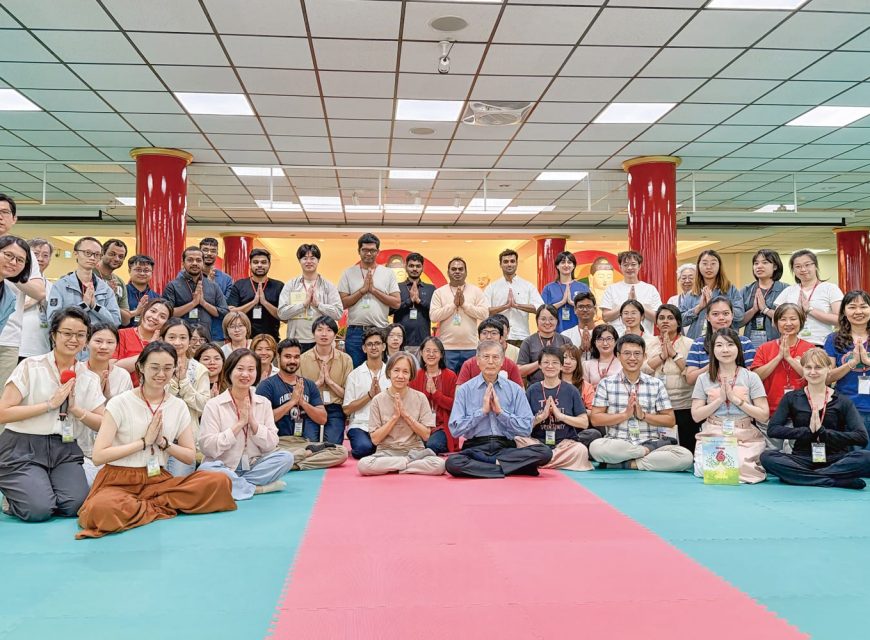
Within a sanctified Buddhist hall or Zen center, the space is filled with pure light. If the heart is still and the body is settled, you can feel this pure light flowing continuously into you.
Harmonious Transformation; Dharma Bliss and Sovereignty
Furthermore, regarding the heart─which refers to the consciousness within your own mind (Heart-Mind)─you must not let sensory attachments take root. This begins with the five senses; they must not be allowed to cling to their objects. While this may sound like a general instruction, you must realize how to transform sensory inputs into wisdom. Once you awaken, true wisdom emerges.
This transformation process is one of harmony, not confrontation. Therefore, the heart must be boundless, pure, and equal. In this state, harmony emerges naturally, Dharma bliss arises spontaneously, and inner freedom─true sovereignty─naturally follow. Guided by Dharma bliss and inner freedom, there are no longer afflictions, delusions, or sensory attachments. In this state, you are a Pure Buddha—the Buddha of Great Sovereignty.
We should appreciate the painstaking efforts of Grandmaster Bodhidharma in traveling to the East to spread the Heart-Imprint Dharma. The Heart-Imprint Buddhist Dharma and Heart-Imprint Zen Dharma have endured because they are beyond learning or action, and they are the natural Way. As long as you possess a sincere heart to achieve Buddhahood and reach the other shore—rather than seeking a Buddha or a Dharma outside of yourself—you will not be trapped by external circumstances or the constraints of time and space. If you advance single-mindedly on the path of Buddha-nature, I can say with confidence: the Buddha-land is near. As it is said in Christianity: “The Kingdom of Heaven is at hand.”
English Translation: Chueh Miao Dao-Lian, Chueh Miao Gong-Ming
看下一篇文章
看上一篇文章