


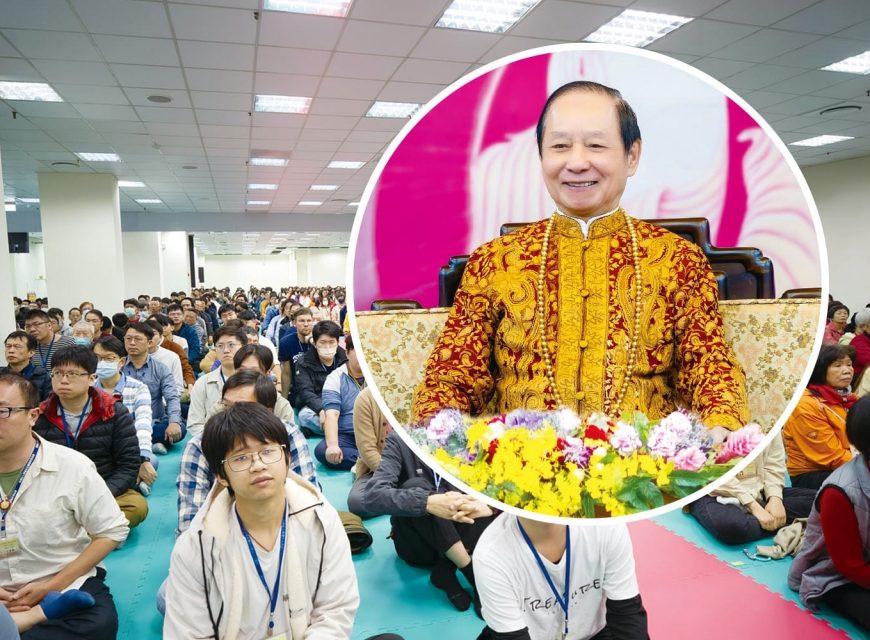
Impartation: Grandmaster Wu Chueh Miao-Tien, the 85th-Generation Grandmaster of Buddhist Zen School
A female practitioner shared that she is getting married next month and planning a fifty-table banquet. A Buddhist layperson suggested that she must host a vegetarian banquet; otherwise, her husband’s family would face misfortune, the marriage would be unhappy, and her husband might even suffer a car accident. These consequences were supposedly due to the killing of animals for the wedding feast. Being a firm believer in karma, she felt deeply distressed and didn’t know what to do.
Shifu (Grandmaster Wu Chueh Miao-Tien) told her: “Wisdom dispels ignorance.” First, on what basis did this layperson make such a claim? So many people attend wedding banquets—is it possible they all suffer misfortune? Second, if he truly possessed the spiritual vision to foresee such a scenario, he should be able to help resolve it rather than simply letting misfortune happen. If one lacks the ability to resolve a situation, or does not know how, one should not cause others unnecessary fear and panic.
Many people say things that cause anxiety. However, will misfortune truly occur? In reality, such things should be laughed off and ignored. Otherwise, is this practitioner supposed to just cancel her wedding?
I told her that getting married and hosting a banquet are perfectly fine. Eating vegetarian is simply an expression of human compassion. In studying the Buddhadharma, we must understand the core teachings. Vegetarianism teaches us to have a compassionate heart; if no one ate meat, no one would kill animals. Thus, it is based on compassion. However, this does not mean that eating vegetarian makes you a Buddha, or that eating meat prevents you from becoming a Buddha.
In other words, eating meat or being vegetarian is not the determining factor in attaining Buddhahood. I (Shifu) highly encourage a vegetarian diet; however, many vegetarians are not actually compassionate because they do not understand the true purpose for eating vegetarian.
Generally, meat-eaters tend to have more aggressive temperaments, while vegetarians are gentler, but this isn’t always true. Some vegetarians have terrible tempers. Ultimately, the most important purpose of a vegetarian diet is to “cultivate the heart” and maintain compassion.
Subheading: Raising Animals to Tame Animal Nature
This leads to a topic I would like to explore: Some international animal protection organizations believe animals should be released back into their native habitats because that is where they belong. This is a human assumption based on the belief that they will live better lives there.
However, my view is the opposite. I believe these animals should be raised by humans to transform their animal nature. Take wild boars and domestic pigs, for example. The former are fierce and prone to biting, while the latter are more docile; the same applies to dogs.
From the perspective of a Buddha, the hope is that sentient beings will stop killing one another. How can this be achieved? By transforming their animal nature. If animals are raised by humans generation after generation, they will become more and more docile. Conversely, if released into the wild, they will become fiercer and their animalistic instincts grow stronger.
If there were a world where humans did not harm animals and animals did not harm humans, that would be a Pure Land on Earth. However, if we only want to protect animals, yet allow their wild nature to develop to the point where they can harm humans, that is not necessarily a good approach.
Furthermore, if wild animals must return to the wild, humans were originally wild too—should we all return to the deep mountains and live like primitives?
Therefore, we should raise them well, tame their wildness, and transform their original fierce nature into a docile one. After several generations of living close to humans, their wild instincts will gradually fade.
Returning to the topic of vegetarianism, although practitioners of Tibetan Vajrayana are all Buddhists, they eat meat because vegetables cannot grow in Tibet. So they can only eat meat. In reality, our internal organs, cells, and blood are also sentient beings that require nourishment. Before we attain Buddhahood, we must first make offerings to these sentient beings within our bodies. Unless these sentient beings have already adapted to a vegetarian diet, do not force yourself.
Subheading: A Vegetarian Heart Matters More Than Whether You Eat Meat or Vegetables
The most important thing is a “Vegetarian Heart”—having a compassionate heart. For example, it is popular to keep pets now. You might care for them well. However, one day you abandon them or release them into the wild. If the animal lacks survival skills, it will likely die. That is not compassion.
Therefore, whether you eat meat or vegetarian food does not matter; there is no need to be obsessive about it. If you reach a certain stage in your cultivation where you prefer lighter food, then eat lighter. If you can abstain from meat, then do so. If you want to eat meat, then eat meat. Be at ease and natural.
Having a compassionate heart is far more important than eating meat or being vegetarian, because a vegetarian heart (pure heart) matters most.
English Translation: Chueh Miao Dao-Lian, Chueh Miao Gong-Ming


|













關注我們
加入Line@官方帳號