

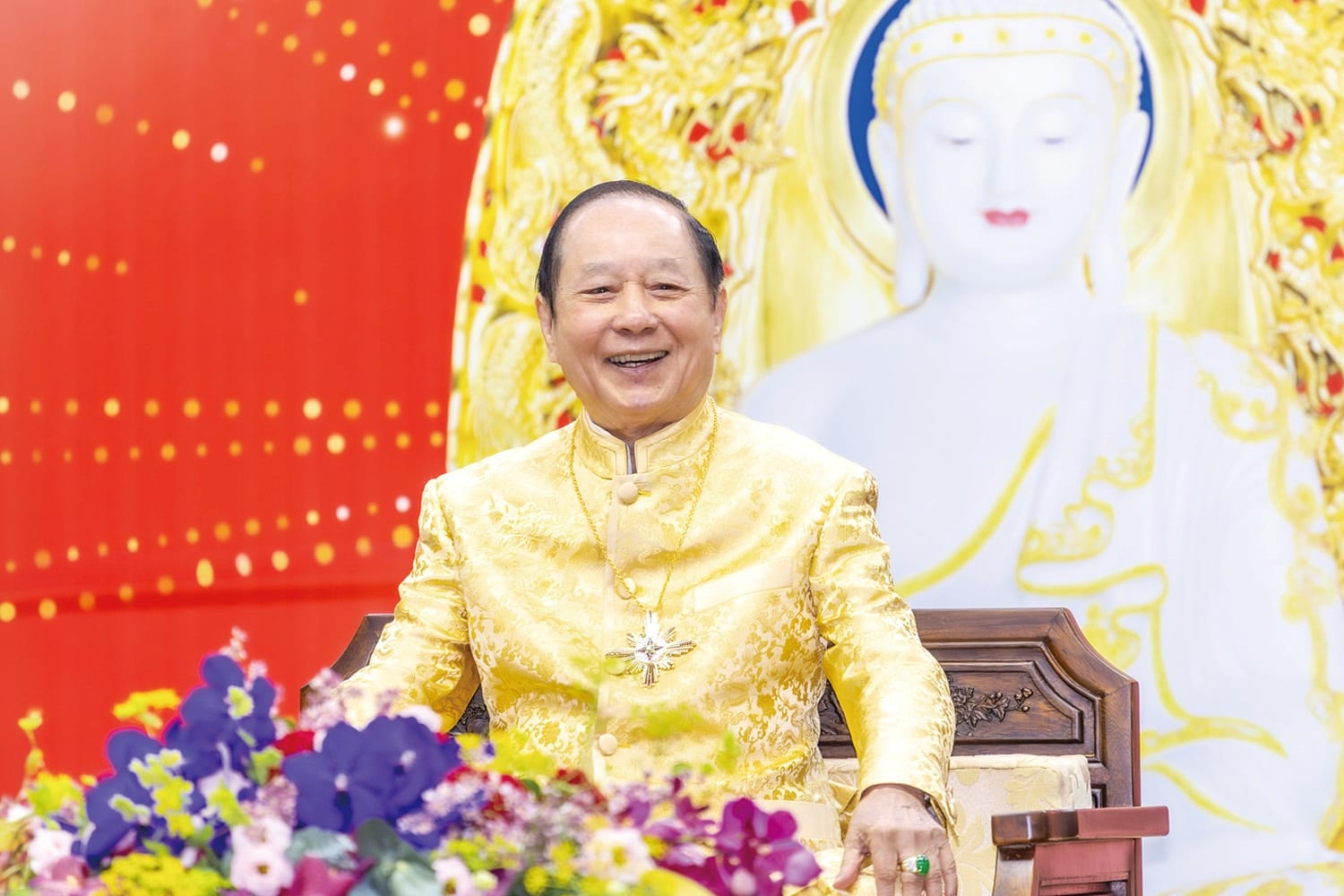
Dharma Teaching: Grandmaster Wu Chueh Miao-Tien, the 85th-Generation Grandmaster of Buddhist Zen School
Zen practitioners who are beginning their spiritual practice must first establish the correct goal for their practice, which means recognizing why they are practicing.
When a person is born into this world and grows up gradually, after going through education and learning from society, they will gradually develop a need for spiritual practice and begin to think about matters related to it.
Spiritual practice exists in both the East and the West—for instance, Buddhism in the East, and Christianity and Catholicism in the West, along with various other religions; they simply differ in their methods of practice.
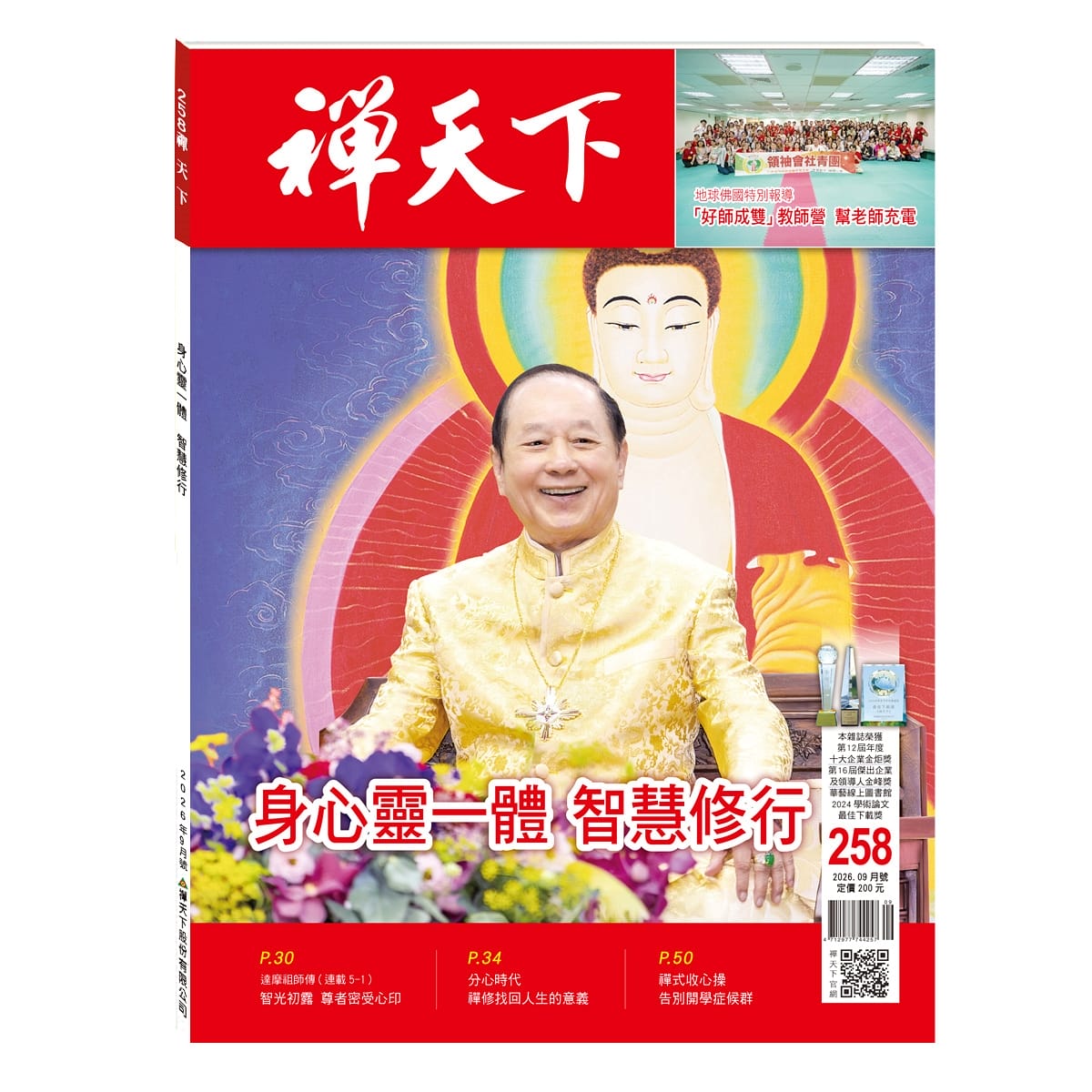
Body, Mind, and Spirit: Integrated Cultivation as One
Western spiritual practice places great emphasis on faith: so long as one believes in God, one may enter Heaven in the hereafter and avoid descent into hell. Eastern Buddhism holds a comparable perspective; yet most crucially, beyond faith, Buddhism incorporates the realization of “how one actually reaches the Buddha Land,” which necessitates the cultivation of wisdom.
What is the cultivation of wisdom? It requires comprehending our physical body (physiology), our mind, and our spirit. The body is a material form, whereas the psychological realm originates from the spiritual body; whether this spiritual body embodies wisdom or ignorance directly determines the plane of the spirit. For wisdom elevates the spirit upward, while ignorance causes it to descend.
Furthermore, the paramount foundation of cultivating wisdom is to realize that our inner spirit is unarising and unceasing—it possesses eternal life—whereas the external physical body is subject to birth and cessation.
Today we are born into human form, outwardly bearing the appearance of a “human.” When this “human” physical body perishes, the spirit departs. Where will the spirit transmigrate next? This is a profoundly solemn question; hence, one must comprehend the cultivation of wisdom.
Purifying Karmic Transgressions and Discerning the Proper Dharma Gate
Perhaps the average person assumes that Western spiritual practice is far simpler: merely believing in God ensures entry into Heaven. Yet I believe this is not entirely the case; that is why they attend church services each week to worship and pray to God. In truth, this too is a form of Dharma assembly, a form of spiritual practice to cultivate inner purity. However, it does not emphasize how to eliminate one’s deep-seated negative tendencies—what are termed karmic transgressions—in the manner that Buddhism does.
God proclaims that all humans possess original sin. Buddhism likewise states that sentient beings carry karmic transgressions and karmic hindrances. In truth, original sin is karmic hindrance. Therefore, only when original sin—that is, karmic hindrance—is emptied and completely purified, can one ascend to Heaven and enter the Buddha Land.
The World-Honored One instructed us that this must begin with spiritual cultivation, and the very first step of cultivation is moral discipline: “precepts.” What must one observe precepts against? One must guard against the recurring afflictions we so frequently commit—greed, anger, ignorance, arrogance, and doubt—for these five poisons are the principal hindrances preventing an individual from entering the Buddha Land.
To return to the fundamental question: Why must humans cultivate? Since both Eastern and Western traditions urge us to practice, we must look deeper into how cultivation should be practiced. First and foremost, one must discern and choose the proper Dharma Gate—that is, deciding which religion to practice and which path to undertake—in order to fulfill the ultimate objective of cultivation: to be reborn in Heaven, to attain rebirth in the Buddha Land.
Therefore, from the very moment one resolves to embark upon the path of spiritual cultivation, selecting which school or lineage to pursue is of paramount importance. Buddhism, for example, encompasses numerous traditions, and we must choose an authentic, orthodox path. How should one make this choice? For instance, some claim they have attained Buddhahood, yet when asked what Dharma lineage they have inherited, they reply that it is inconsequential. In my view, throughout the entire path of the Buddha, no such teaching exists. For how could a teacher without the lineage transmission of the Buddha and without authentic realization lead those who follow him to the Buddha Land?
To serve as a Dharma-transmitting Master, one must intrinsically attain the prerequisites of a Buddha, having received the transmission from a Master endowed with the authentic lineage of the Buddha, thereby fully possessing the realized spiritual power of a Buddha.
In other words, only an enlightened Master who has attained true realization can guide the spirits of those cultivating alongside Him back to the Buddha Land. Therefore, Shifu bear the sacred responsibility today to guide all of you—the Zen Bodhisattvas cultivating with me—back to the Buddha Land together.
Liberation from Samsara, Nirvana Without Remainder
The so-called True Dharma is that which empowers all suffering spirits—those who have ceaselessly suffered throughout past, present, and future within the transmigration of the six realms—to truly break free from the immense agony of samsara starting from today, starting from this very lifetime, and attain the supreme bliss of the Buddha Land. Such a teaching alone constitutes the True Dharma.
Therefore, as you all cultivate alongside Shifu, how can you know through your practice that you will return to the Buddha Land with Shifu in the future? Above all, you must harbor unshakeable faith. Because Shifu has inherited the lineage transmission of the World-Honored One, and the World-Honored One declared to us that every sentient being possesses Buddha-nature, fully endowed with the virtuous hallmarks of the Tathagata, and is capable of attaining Buddhahood. The Buddha Land is our true celestial home; hence, we can surely return. You must hold fast to this profound faith.
Yet, although every person inherently possesses Buddha-nature, the critical difference lies here: no one knows through how many lifetimes their Buddha-nature has transmigrated, imperceptibly accumulating countless impurities along the cycles of rebirth—what are termed karmic transgressions—even while gathering abundant merits. The true goal of spiritual cultivation is to attain Parinirvana Without Remainder, not Nirvana With Remainder.
Nirvana Without Remainder signifies attaining rebirth in the Buddha Land in pristine purity, without bearing the slightest karmic transgression. Nirvana With Remainder, by contrast, entails rebirth carried over with lingering karma; thus, one must transmigrate once again in the next life, potentially wandering across millions of years until one has attained absolute purity, where not a single trace of karma remains. Therefore, Nirvana With Remainder is not a completely fulfilled cultivation—it is neither the Great Perfect Enlightenment nor Wondrous Enlightenment. From this, the paramount importance of spiritual cultivation becomes undeniable.
We often see Christians make the sign of the cross over their chests, moving from the left shoulder to the right, and from the forehead downward. Yet many people—even Christians themselves—do not comprehend what this truly signifies; they only know how to perform the outward gesture.
Tracing across the chest horizontally represents the mortal world; pointing upward represents ascending to Heaven; pointing downward represents descending into hell. That is to say: from this mortal world, will you ascend to Heaven, or descend into hell?
If one ascends to Heaven, this sign of the cross radiates the Cross of Light; if one descends into hell, it turns into a heavy crushing cross of suffering, for there is no light in hell.
Myriad Virtues and Sublime Dignity, Attaining Buddhahood
The Buddhist swastika (卍) symbolizes “myriad virtues and sublime dignity,” which signifies the attainment of Buddhahood. In other words, when a spiritual practitioner cultivates to complete purity, realizes Prajna wisdom, and perfects all merits, one obtains the realized spiritual power of myriad virtues, attaining Buddhahood. Sublime dignity directly conveys the attainment of Buddhahood.
Therefore, through genuine spiritual cultivation, a person can indeed attain Buddhahood within the Pure Land of the World-Honored One. The Pure Land of the World-Honored One is the Buddha Land on Earth, and His vow is: “A Buddha Land on Earth, Everyone Attains Buddhahood.” Because every person inherently possesses Buddha-nature, everyone can attain Buddhahood.
If all humanity across the globe cultivated in accordance with the World-Honored One’s teaching of “Precepts, Dhyana, Prajna Wisdom, and Liberation”—beginning with upholding the precepts, then cultivating Zen meditation, and advancing until Prajna wisdom is realized—they could liberate their spirit from samsara and return home to the Buddha Land. The World-Honored One revealed with utter clarity that we must cultivate wisdom in this very way. (This article is compiled from “Heart-Imprint Buddhist Dharma: The Dharma Gate of Wisdom,” Volume I and DVD)
English Translation: Chueh Miao Gong-Ming, Chueh Miao Dao-Lian
|
|












關注我們
加入Line@官方帳號