
Text by: Hsieh Ming-Yuan, Hsieh Ai-Chu
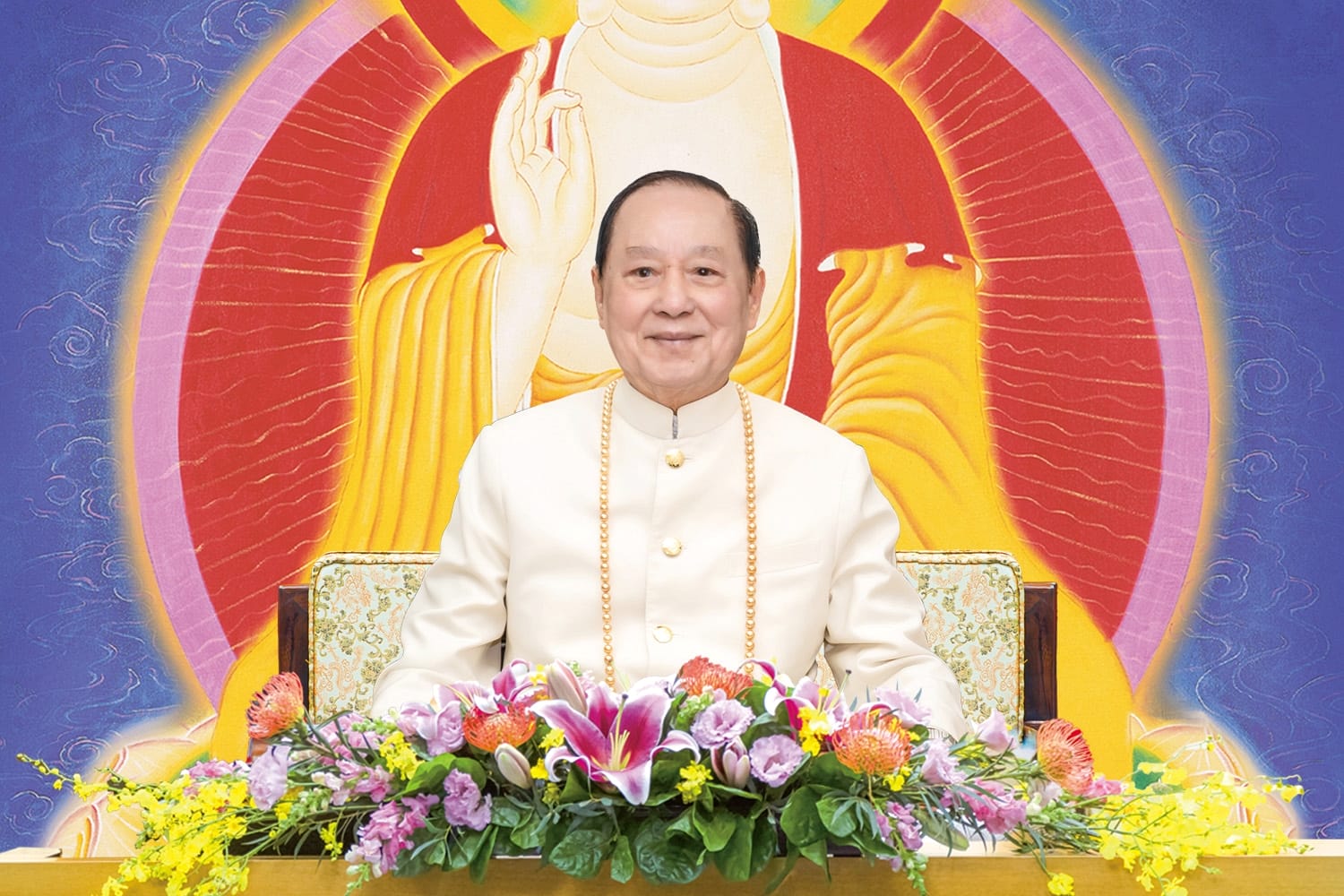
Photo Courtesy of Shakyamuni Buddhist Foundation
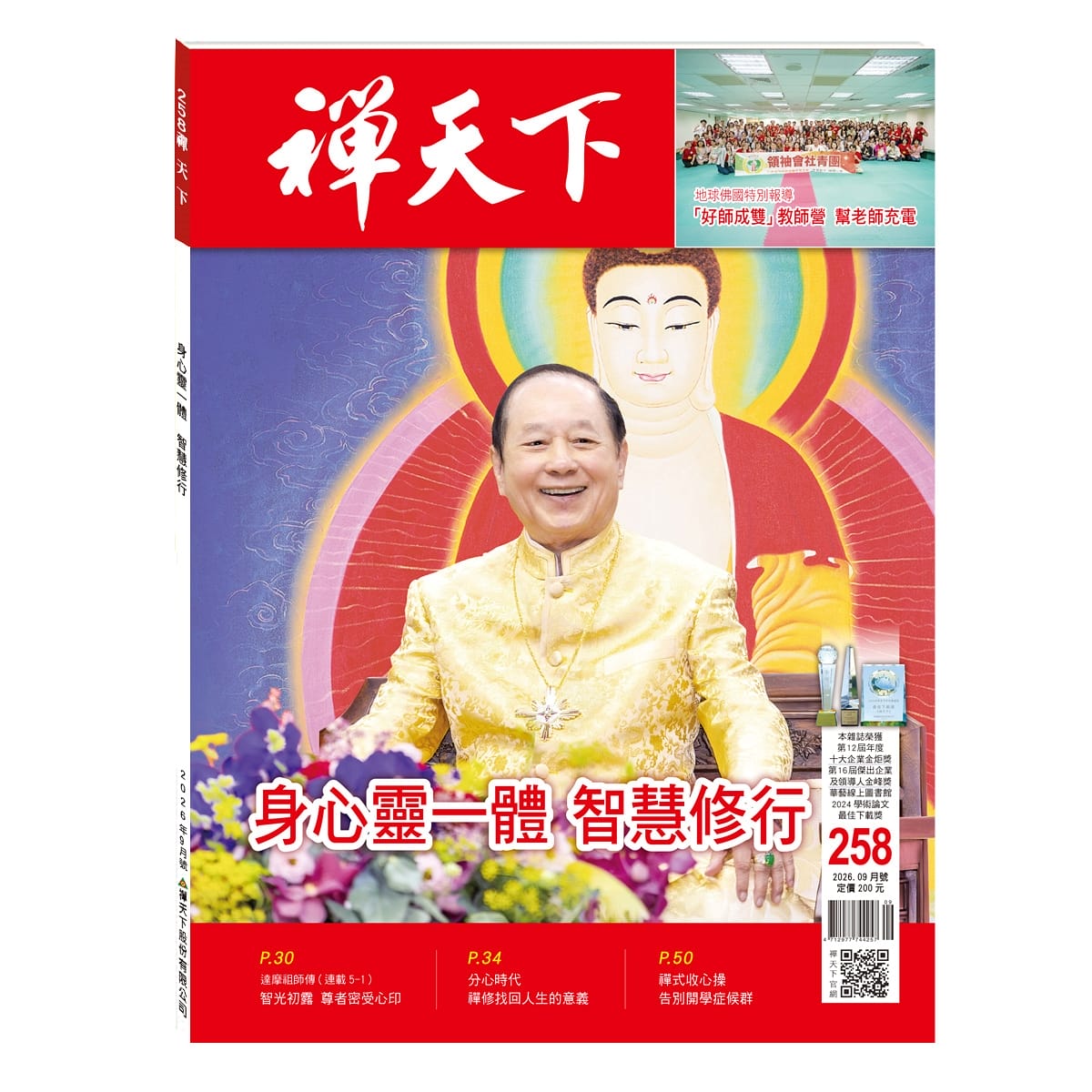
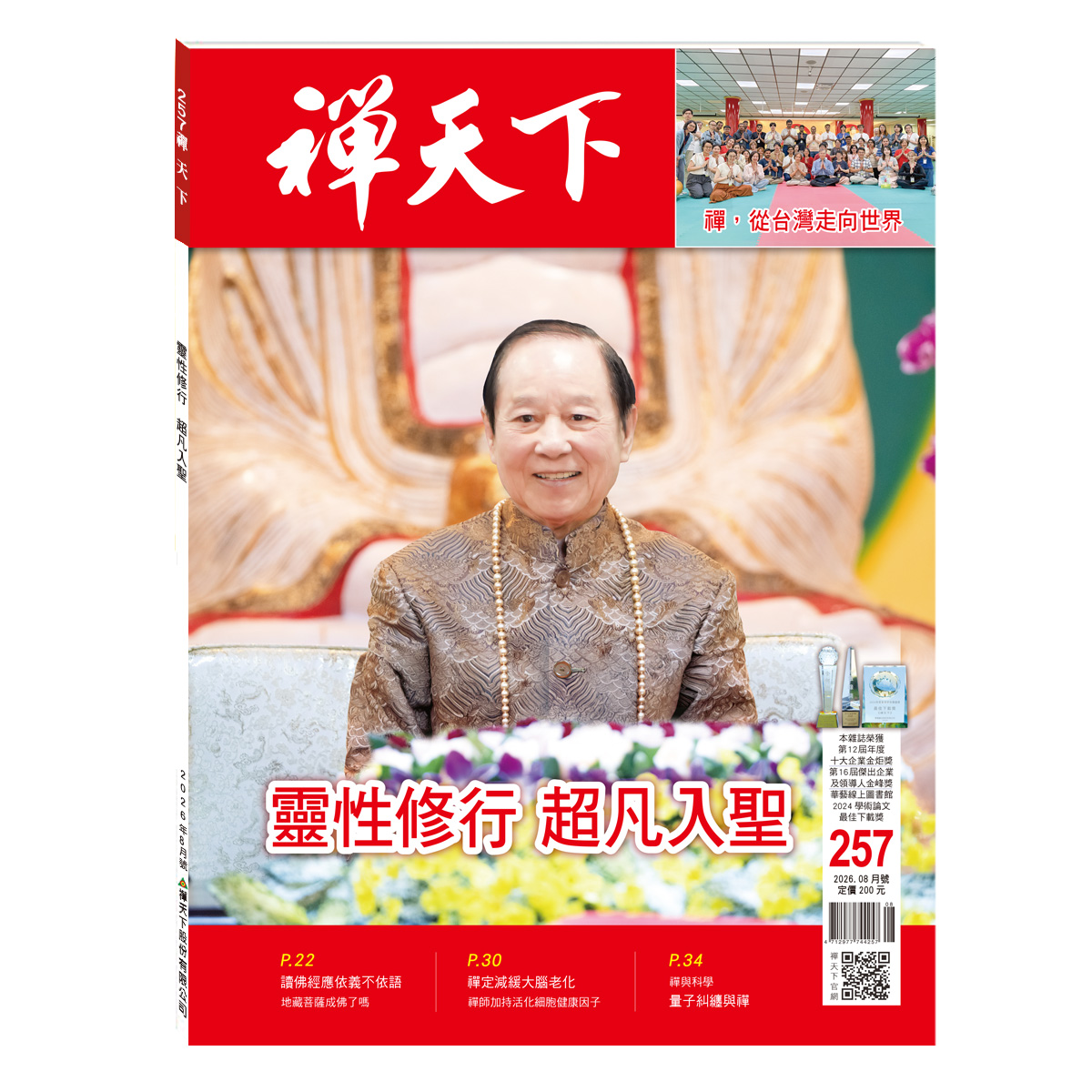
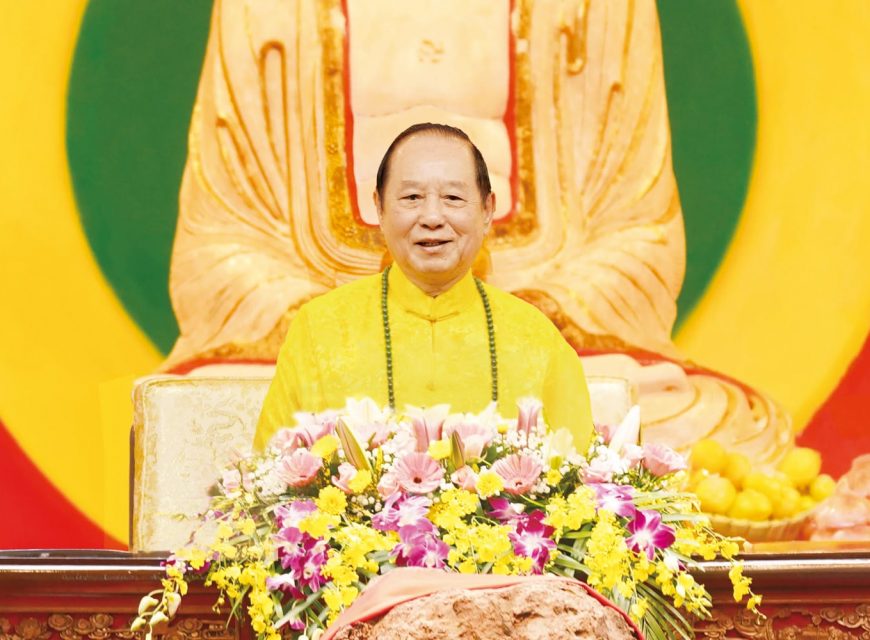
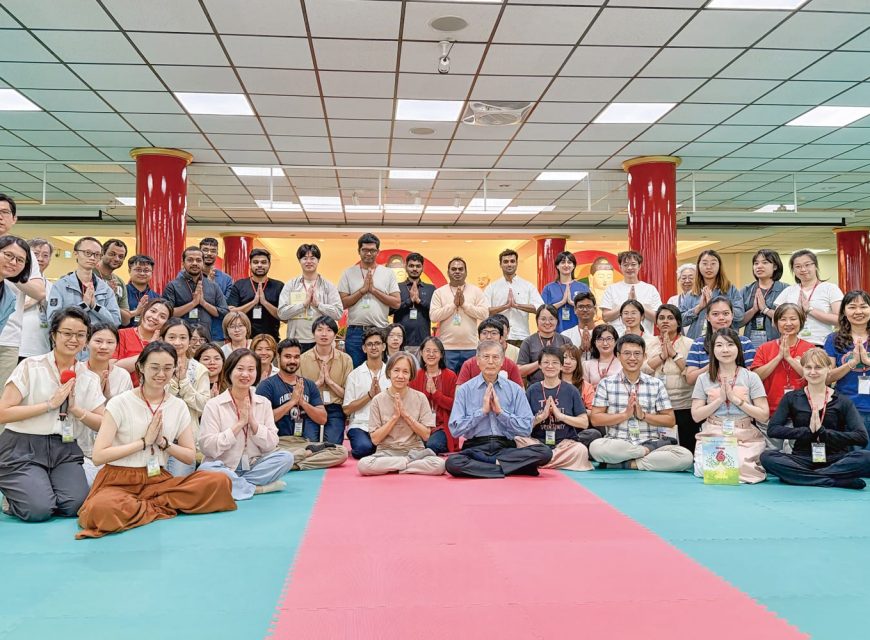
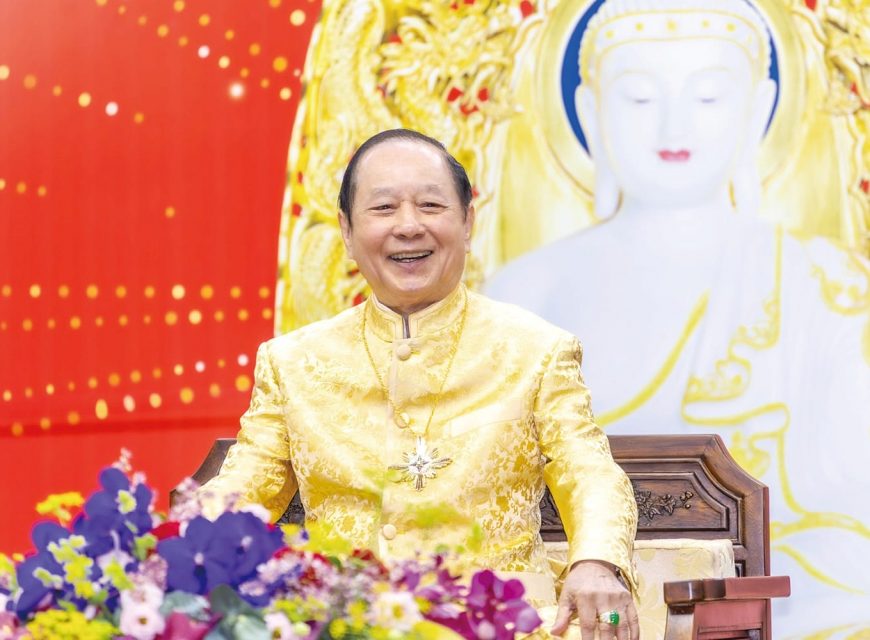
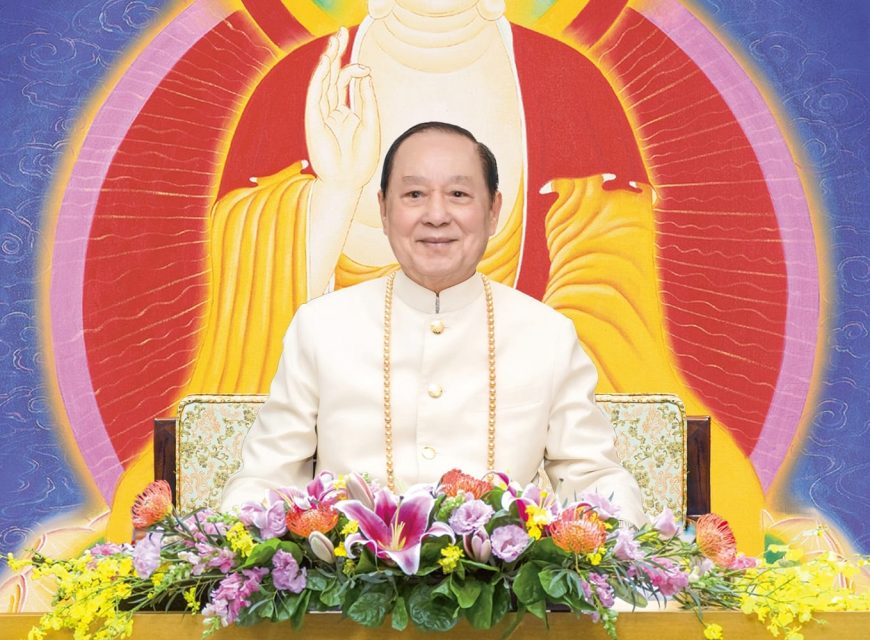
On September 5 last month, Zen Grandmaster Wu Chueh Miao-Tien, the 85th-generation Grandmaster of the Zen School, bestowed Dharma transmissions and discourses to disciples worldwide via an in-person gathering and live broadcast from the Nangang Grand Zen Center of the Shakyamuni Buddhist Foundation in Taipei. Amidst the prevailing turbulence across both the international landscape and Taiwan, attendees felt as though they were abiding within a pristine Pure Land, their hearts filled with resolute vows.
Prior to the formal commencement of the assembly at ten o’clock in the morning, all practitioners settled into their own Zen meditation, preparing to receive the sweet dew of the Dharma from Shifu, Grandmaster Wu Chueh Miao-Tien. Shifu opened directly with an essential inquiry: “Throughout the forty-three years Shifu has transmitted the Dharma, what aspect of the Dharma Door has been imparted?” He then expounded: “First is the ‘body,’ second is the ‘mind,’ and third is the ‘spirit’—which is the spiritual essence itself.”
The Law of Nature (Cultivating the Body): Conserving Energy, Remaining Ever-Green
Regarding the physical body, the Zen Grandmaster established the Ten-Chakra Zen Meditation: “This is the cultivation of the Ten-Chakra Vajra (Diamond) Body, which empowers everyone to attain a Vajra Body.”
The Grandmaster expounded that these ten chakras serve as the vital life-energy centers of the physical body. In Zen meditation, one focuses on a specific chakra to generate an energy field. Taking the Navel Chakra as an example, the Grandmaster noted that many beginners find it difficult to concentrate: “This requires proper methodology—one must harness the power of concentrated focus.”
The Grandmaster expounded that focusing on a chakra is not merely looking at it or touching it: “You must immerse your entire physical being into it; your whole mental and spiritual power must enter within. Focus on the chakra in this manner, using the power of one-pointed focus to develop and unlock the internal energy, and subsequently transmit it throughout the entire body.”
“For instance, when focusing on the Navel Chakra, deeply immersing your spirit inside is just like your entire body entering it. You enter to unlock its latent energy and then circulate it throughout the whole body. You will directly perceive and verify your capability to radiate this energy across your entire body.”
The Grandmaster explained that focusing on the chakras during Zen meditation reaches the true standard only when practiced in this way. When all ten chakras are cultivated to this degree, “it is equivalent to clearing all blockages throughout the entire body, keeping the physical frame continuously abundant with energy.”
“The foremost priority in Zen cultivation is enabling the body to ‘conserve energy,’ thereby allowing one to ‘remain naturally ever-green.'”
Because this energy is the very energy of life, if one can constantly preserve this vitality, “one can remain naturally ever-green, like the enduring pine and cypress—attaining longevity and youthful vitality. Therefore, you must master undivided concentration and firmly grasp that pivotal point.”
How can one preserve life energy? The Grandmaster cited speaking as an example: speaking expends life energy, and the louder the voice, the greater the depletion.
“Hence, when two people converse, it suffices that they hear each other; do not speak too loudly, so as to conserve life energy. Particularly during moments of anger or emotional agitation, one’s voice naturally rises, severely draining energy. One must pay special heed to this.”
The Grandmaster reminded practitioners of daily lifestyle habits: when urinating, it is best to rest the tip of the tongue against the upper palate to prevent the depletion of kidney Qi. Furthermore, visual exertion also consumes energy; modern people frequently gaze at mobile phones for extended periods until their eyesight deteriorates—self-control is essential.
Furthermore, mental rumination and discursive thinking also consume energy. Dementia in some elderly individuals stems from failing to properly nurture the brain in their youth. Therefore, refrain from delusive thoughts in daily life to avoid draining your mental energy.
Beyond preventing the dissipation of life energy, the Grandmaster expounded that replenishing life energy is even more crucial. Ordinary people replenish vitality through three daily meals, yet the Grandmaster expounded that one must also guide internal Qi to fortify life force.
“One must sublimate the vitality of ‘Qi’ into the tier of ‘electricity,’ thereby making the physical body robust and resilient. Do not merely sit and listen; rise and put this into practice. Only by truly cultivating and verifying the Buddha Dharma transmitted by Shifu can one comprehend its sublime benefits and wonders.”
The Grandmaster illustrated that if any deficiency exists within the body, one should direct the Qi to channel energy into that area, or recharge sections that have been wasted and depleted. How does one recharge? “On one hand, apply the Ten-Chakra Zen Meditation method. On the other hand, we dwell between heaven and earth. As Wen Tianxiang proclaimed, ‘Between heaven and earth resides the righteous Qi’; I proclaim, ‘Between heaven and earth reside spiritual Qi and the Qi of life.’ How do we obtain it? First, bring yourself into ‘stillness’; then, within Zen meditation or serene stillness, you can receive it.”
The Grandmaster further elucidated: “Because when one is in stillness, the ‘body and mind unite as one.’ At that juncture, the physical body (Hun) and spiritual body (Po) merge together. You must sense Hun and Po unified, and then receive the life energy descending from above, from heaven and earth.”
“Replenishing brainpower follows the identical principle: receive the wisdom energy of heaven and earth to nourish your mental faculties.”
“If one can genuinely accomplish this, one will directly perceive and definitively know that one has acquired that strength and received that life energy, thereby gaining the ability to govern the health of one’s own physical body.”
How does one govern it? “You can utilize your spiritual body to contact the five visceral organs and six hollow organs. If their response is favorable, it indicates health; if the response is poor or manifests discomfort, an issue exists, and you must direct greater meditative observation to that area. Once you can govern your physical body, you will gradually accumulate experience to govern your own life.”
The Grandmaster remarked that the Dharma He transmits is neither overly exalted nor unattainable; in reality, it is straightforward—one realizes it simply by practicing faithfully. As the saying goes, “advancing step by step to higher grounds,” one must begin practicing from the simplest foundation: breathing.
“We breathe continuously, yet few people pay attention to how to breathe properly. One must inhale down into the abdomen, employing abdominal breathing. Gradually, you will disregard nasal breathing, because the nose breathes naturally, just as the heart beats spontaneously.”
The Grandmaster delineated the steps of abdominal breathing in detail: “As the belly expands, air enters; as the belly contracts, air expels. This is abdominal breathing, which must be cultivated until it becomes completely natural.”
When abdominal breathing is mastered proficiently, it can be applied in daily life. The Grandmaster cited dental visits as an example: lying on the dental chair with the mouth open, one occasionally feels that nasal breathing is obstructed; during such moments, one can readily employ abdominal breathing. “Once you have learned the Dharma transmitted by Shifu, you must know how to apply it in everyday life.”
Right at the beginning of the discourse, the Grandmaster stated clearly that the Dharma He transmits encompasses the three dimensions of ‘body, mind, and spirit,’ and what He imparts regarding the physical body is the Law of Nature.
“The so-called Law of Nature embodies the natural phenomena of the cosmos. Living between heaven and earth, humans are just like plants—both receiving the spiritual Qi of heaven and earth. Plants absorb nutrients and moisture from the soil alongside sunlight from above, synthesizing chlorophyll to nourish their growth. Likewise, our physical bodies must grow naturally just like plants. How should we proceed? Observe how a tree grows; take trees as your teachers, especially ancient giant trees. Meditatively contemplate how they mature into towering giants, and learn from them.”
The Grandmaster stated that the great earth can serve as our mentor; our physical body is an epitome of Nature. Hence, in practicing the Law of Nature, one must accomplish: “Conserving energy, remaining ever-green.” These words sum up the practice of the Law of Nature in cultivating the ‘body.’
The Grandmaster also exhorted that in everyday life, being able to eat well and sleep soundly is essential. These are critical aspects in physical cultivation, and one must remain mindful of bodily health.
“When you can conserve energy, naturally attain longevity, and naturally maintain youthful vigor, the primary objective of ‘cultivating the body’ is fulfilled.”
The Law of Great Ease (Cultivating the Mind): Joyful and At Ease, Practicing Endurance to Radiate Light
Second is cultivating the mind. How should one cultivate the mind? The Zen Grandmaster expounded that one must remain joyful and at ease, embracing a blessed life with such a mindset—this is the Dharma Door of Great Ease.
“Your mind must be fully at ease, free from hindrances, completely unobstructed, without stress, lighthearted, and serenely unburdened. What the mind must strictly avoid is anger, hatred, resentment, jealousy, and holding grudges; none of these can be retained within the heart. Otherwise, one ceases to be a true Zen practitioner and is not cultivating the Heart-Imprint Dharma Door. Once these negative states arise, they ignite the fire that burns down the forest of merits, reducing all previous spiritual efforts to naught,” the Grandmaster earnestly exhorted all disciples.
The Grandmaster remarked that He is joyful every day and never gives rise to anger. “Refraining from anger is the practice of the Paramita of Endurance (Kshanti-paramita); this corresponds to cultivating the Third Ground of the Ten Ground Bodhisattvas, the ‘Ground of Radiance’ (Prabhākārī).”
“Because being able to practice endurance signifies that your power of purity and meditative stability are sufficient; consequently, you perceive the light. This demonstrates how paramount the mind is. Spiritual practice without cultivating the mind amounts to futile effort. For instance, many who read Buddhist sutras fail to elevate their body, mind, and spirit through them, which renders their reading ineffective.”
The Grandmaster expounded that one must apply the wisdom of the Buddhist sutras to elevate the body, mind, and spirit. Yet among the vast corpus of scriptures, not all stem directly from the World-Honored One’s own words; many were written by later masters. “The original teachings of the World-Honored One were handed down across generations, and compilation into scriptures only commenced two to three hundred years after His Parinirvana, inevitably introducing deviations from the original truth.”
Regarding the Pure Land, Zen Grandmaster Wu Chueh Miao-Tien revealed a heavenly mystery: “The prerequisite for entering the Western Pure Land of Ultimate Bliss is purity alongside the accumulation of merits; even if one’s merits are not yet flawless, one may achieve rebirth carrying residual karma.”
The Grandmaster expounded that what the World-Honored One transmitted is the Dharma Door of Zen meditation, which requires purifying body, speech, and mind through a pure heart. In other words, one’s physical conduct, spoken words, and thoughts must never violate the precepts; thereby, one accomplishes purity and enters emptiness.
The Grandmaster expounded that spiritual cultivation demands physical emptiness, cognitive emptiness, and mental emptiness. If one can purify body, speech, and mind, one attains the fundamental initial step toward accomplishment. “To attain the state of Tathagata Buddha, spiritual practice must attain absolute emptiness—physical emptiness, cognitive emptiness, and mental emptiness—meaning freedom from any trace of defilement.”
The Law of Great Freedom (Cultivating the Spirit): Holy Spiritual Wisdom, Soaring Freely
Third is the cultivation of the spirit. How should one cultivate the spirit? One must cultivate the wisdom of the Holy Spirit, which is described as ‘Holy Spiritual Wisdom, soaring freely.’ “Your spirit is inherently free and can travel to any Pure Land.”
Endowed with the wisdom of the Holy Spirit, one can soar freely. The Grandmaster expounded: “Cultivating the body is the Dharma Door of Nature; cultivating the mind is the Dharma Door of Great Ease; cultivating the spirit is the Dharma Door of Great Freedom, liberating our spirit to soar freely and travel to any Pure Land.”
The Grandmaster remarked that He transmits the Dharma with utmost clarity, delineating explicitly how to cultivate the body, mind, and spirit. However, He speaks comparatively less about cultivating the wisdom of the Holy Spirit, “because you have not yet attained that level.”
The Grandmaster expounded that to acquire the wisdom of the Holy Spirit, one must comprehend the relationships within the cosmos. What relationship? “The entire universe is fundamentally the interrelation of space and time. In Chinese, Yu represents space and Zhou represents time; space and time constitute the whole cosmos. What is the relation between them? The larger the space, the longer the time; the smaller the space, the faster the time.” The Grandmaster illustrated that traveling from Taipei to Taichung is closer than to Kaohsiung, so the transit time is shorter.
“From this, we see that spatial wisdom is essential; the greater our spatial wisdom, the longer time flows into our realm.”
“For example, one day in the Tushita Heaven equals four hundred years in the human realm; the Tushita Heaven is the abode of Maitreya Buddha before His final rebirth. In other words, if you practice Zen meditation for one hour in the Tushita Heaven, it equals approximately sixteen years and eight months of spiritual cultivation in the human realm, conferring sixteen years and eight months of spiritual attainment.”
The Grandmaster emphasized that Zen meditation is vital: the moment one sits, one enters immediate purity, stepping into another space-time of transcendent wisdom rather than indulging in discursive thoughts.
“To cultivate the wisdom of the Holy Spirit, one must master and apply time and space. For example, as I often say, can an undertaking originally slated for one year be accomplished in six months? Or even within a single month, a single week, or one day? This is the integrated application of spatial wisdom and temporal wisdom.”
Understanding how to navigate space and time enables one to know how to streamline and manage enterprise or work. This is of critical importance, as modern corporate management prioritizes simplification, orderly sequence, and standard operating procedures (SOPs) to prevent chaos.
The Grandmaster expounded that spiritual cultivation is the trinity of cultivating the ‘body, mind, and spirit’—this is the very Dharma Door capable of realizing the Threefold Body (Trikaya). “What Shifu transmits is the Dharma Door of accomplishing the Threefold Body. In the future, you may ascend to the Western Pure Land of Ultimate Bliss, the Eastern Pure Land of Lapis Lazuli Light, or the Eastern Pure Land of Abhirati. Abhirati is the realm of exquisite joy, also known as the World of Sublime Joy. Therefore, as you practice Shifu’s Dharma Door, you should abide constantly in Dharma joy and ease.”
The Six Paramitas (The Six Perfections)
and Myriad Practices Accomplish the Six-Ground Bodhisattvas
The Grandmaster further expounded in detail: “To attain Buddhahood, one must first become a Bodhisattva. To become a Bodhisattva, one must practice the Six Paramitas and Myriad Practices—namely, the Six Paramitas: Generosity (Dana), Precepts (Sila), Endurance (Kshanti), Diligence (Virya), Zen Meditation (Dhyana), and Wisdom (Prajna). These Six Paramitas enable one to attain from the First through the Sixth Grounds of the Tenth-Ground Bodhisattvas (Note).”
(Note) Bodhisattvas of the Ten Grounds: The First Ground of Joy (Pramudita), the Second Ground of Purity (Vimala), the Third Ground of Radiance (Prabhakari), the Fourth Ground of Blazing Wisdom (Archismati), the Fifth Ground of Invincible Victory (Sudurjaya), the Sixth Ground of Direct Manifestation (Abhimukhi), the Seventh Ground of Far-Reaching Journey (Durangama), the Eighth Ground of Immovability (Achala), the Ninth Ground of Excellent Wisdom (Sadhumati), and the Tenth Ground of the Dharma Cloud (Dharmamegha).
The Grandmaster expounded that a true spiritual practitioner who has just entered the Dharma gate will first inevitably experience Dharma joy. With this joyful heart, they will naturally share their personal spiritual testimonies with acquaintances and strangers alike. This constitutes the first paramita, “Joyful Generosity,” attaining the First-Ground Bodhisattva of Joy. “The ‘Ground of Joy’ means giving generously with joy and reaching out to guide others into the Dharma.”
The Second Ground is the Bodhisattva of Purity. “Cultivating the Bodhisattva of Purity requires observing the precepts—the second paramita of Precepts. One must uphold the precepts of body, speech, and mind. When body, speech, and mind are purified and no longer violate the precepts, one naturally becomes free from defilements, accomplishing the Second Ground, Bodhisattva of Purity.”
The Third Ground is the Bodhisattva of Radiance, which requires practicing the third paramita of Endurance. “When endurance is mastered, anger does not arise. Just as in Zen meditation, one abides in profound purity, and spiritual light shines forth during sitting—thus reaching the Third Ground, Bodhisattva of Radiance.”
The Fourth Ground is the Bodhisattva of Blazing Wisdom, which requires practicing the fourth paramita of Diligence. Spiritual cultivation demands diligence—diligence across all spiritual practices and all Dharma doors. “Diligence is like a flame that burns away all impurities and defilements, purifying you so that you remain free from stress and worries, thereby attaining the Fourth Ground, Bodhisattva of Blazing Wisdom. The Ground of Blazing Wisdom is the Ground of Diligence. Practicing to complete purity and perfection accomplishes the Fourth Ground, Bodhisattva of Blazing Wisdom.”
The Fifth Ground is the Bodhisattva of Invincible Victory, requiring the practice of the fifth paramita of Zen Meditation. Why does Zen Meditation accomplish the Fifth-Ground Bodhisattva? “Because after entering Zen Meditation, one remains untouched by external conditions; the heart remains immovable, and the Dharma remains immovable. When the mind is steady, practice never regresses. This is Zen Meditation, which accomplishes the Fifth Ground, Bodhisattva of Invincible Victory.”
The Sixth Ground is the Bodhisattva of Direct Manifestation, requiring the practice of the sixth paramita of Prajna Wisdom. When Zen Meditation accesses Prajna wisdom and wisdom expands, one attains the Sixth Ground of Direct Manifestation: “Your true nature manifests directly, the light of true nature reveals itself, and you accomplish the Bodhisattva of Direct Manifestation.”
At this juncture, the Grandmaster exhorted earnestly: “So you see how immensely vital the Six Paramitas are!”
Many do not know how Bodhisattvas of the Ten Grounds attain full realization. The Grandmaster clearly elucidated that the first six grounds correspond directly to the cultivation of the Six Paramitas: “The First-Ground Bodhisattva of Joy practices joyful generosity. The Second-Ground Bodhisattva of Purity practices upholding the precepts. Practicing endurance leads to the Third Ground of Radiance. Diligent cultivation leads to the Fourth Ground of Blazing Wisdom. Practicing Zen Meditation achieves non-regression and unshakeable steadfastness—standing firm with an unwavering Zen heart and solid Zen Dharma—leading to the Fifth Ground of Invincible Victory. Practicing the Prajna Paramita and cultivating Prajna wisdom elevates wisdom, causing the light of the true nature to manifest, thus ascending to the Sixth Ground of Direct Manifestation and accomplishing the Sixth-Ground Bodhisattva.”
The Paramitas of Skillful Means, Vow, Power, and Transcendent Wisdom
How does one cultivate the Seventh-Ground Bodhisattva of Far-Reaching Journey? The Grandmaster expounded that from the Seventh Ground onward, cultivation enters the spiritual realm, belonging to the spiritual world. The Grandmaster then transmitted the essential Dharma guidance: “The Seventh Ground of Far-Reaching Journey occurs when Zen meditation enters another space-time dimension; the spirit departs to journey afar. In other words, the spirit can depart freely, entering and exiting with ease—this is the Skillful-Means Paramita.”
The Eighth Ground is the Bodhisattva of Immovability. “The Ground of Immovability signifies that your spiritual cultivation is exceptionally solid, absolute in its non-regression, advancing stage by stage and ascending step by step without ever backsliding.”
The Ninth Ground is the Bodhisattva of Ezcellent Wisdom, capable of expounding the Dharma with skillful adaptability and engaging in doctrinal debates, much like the rigorous scriptural debates practiced in Esoteric Buddhism. “The Ninth Ground of Excellent Wisdom allows you to expound the Dharma skillfully and flexibly, making it accessible to all so that everyone understands how to practice. Simply put, it means leading and guiding the assembly in cultivation.”
The Tenth Ground is the Bodhisattva of Dharma Cloud. “The ‘Ground of Dharma Cloud’ represents your spiritual attainment ascending to the pinnacle. Upon attaining the ultimate Tenth Ground, the Buddha bestows empowerment and blessings upon you, consecrating you with supreme wisdom. This empowers you to expound the Dharma abundantly like sweeping clouds, propagating the Dharma everywhere to deliver sentient beings.”
The Zen Grandmaster further analyzed the essential cultivation from the Seventh through the Tenth Grounds: “The Seventh Ground of Far-Reaching Journey allows the spirit to enter and exit freely, embodying the Upaya (Skillful Means) Paramita. The Eighth Ground of Immovability represents non-regression, embodying the Pranidhana (Vow) Paramita. The Ninth Ground of Excellent Wisdom deploys inner power to expound the Dharma skillfully, embodying the Bala (Power) Paramita. The Tenth Ground of Dharma Cloud unites all wisdom drawn from practice and divine empowerment from the Buddha, perfecting one’s realization to attain Buddhahood, which embodies the Jnana (Transcendent Wisdom) Paramita.”
The Grandmaster expounded that the ‘Ten Ground Bodhisattvas’ described in Buddhist sutras must be cultivated in this exact manner. “From this, we see that without first becoming a Bodhisattva, it is exceedingly difficult to attain Buddhahood.” Hearing this, everyone felt as though blessed by divine nectar poured over their crowns, awakening with profound clarity.
After cultivating, which Pure Land will one enter in the future? Zen Grandmaster Miao-Tien cited the teachings of the World-Honored One, explaining that Pure Lands encompass the Eastern Pure Land of Lapis Lazuli Light of the Medicine Buddha, the Eastern Pure Land of Abhirati, and the Western Pure Land of Ultimate Bliss.
” The Pure Land of Abhirati is the realm of Akshobhya Tathagata (the Immovable Buddha), where Vimalakirti is a Great Bodhisattva., where Vimalakirti is a Great Bodhisattva. The Western Pure Land of Ultimate Bliss is the realm of Amitabha Buddha; alongside Amitabha Buddha are Avalokiteshvara Bodhisattva and Mahasthamaprapta Bodhisattva, who receive and escort beings to the Pure Land.”
“There is also the realm of Maitreya Buddha—the Tushita Pure Land,” the Grandmaster expounded. “The Tushita Pure Land is the stage of the Buddha’s final rebirth before Buddhahood (ekajati-pratibaddha). Practicing to the Tenth-Ground Bodhisattva leads to this realm, where one attains Buddhahood, or directly realizes the Threefold Body (Trikaya) to ascend straight into the Pure Land.”
The Grandmaster remarked that the World-Honored One expounded two eastern Pure Lands and one western Pure Land, while Esoteric Buddhism features the Five Dhyani Buddhas: Akshobhya Buddha in the East, Amitabha Buddha in the West, Ratnasambhava Buddha in the South, Amoghasiddhi Buddha in the North, and Mahavairocana Buddha in the Center.
This profound discourse concluded auspiciously at 11:00 AM. The entire discourse felt as though Shifu, Zen Grandmaster Wu Chueh Miao-Tien had guided His disciples through all the divine Pure Lands. In closing, Shifu assured everyone with certainty: “Practicing with Shifu, you can travel to any Pure Land.” Hearing this, all rejoiced deeply, vowing to practice the Six Paramitas and Myriad Practices diligently and cultivate the Paramitas of Skillful Means, Vows, Spiritual Power, and Transcendent Wisdom until fulfilling the attainment of the Ten Ground Bodhisattvas.
English Translation: Chueh Miao Gong-Ming