

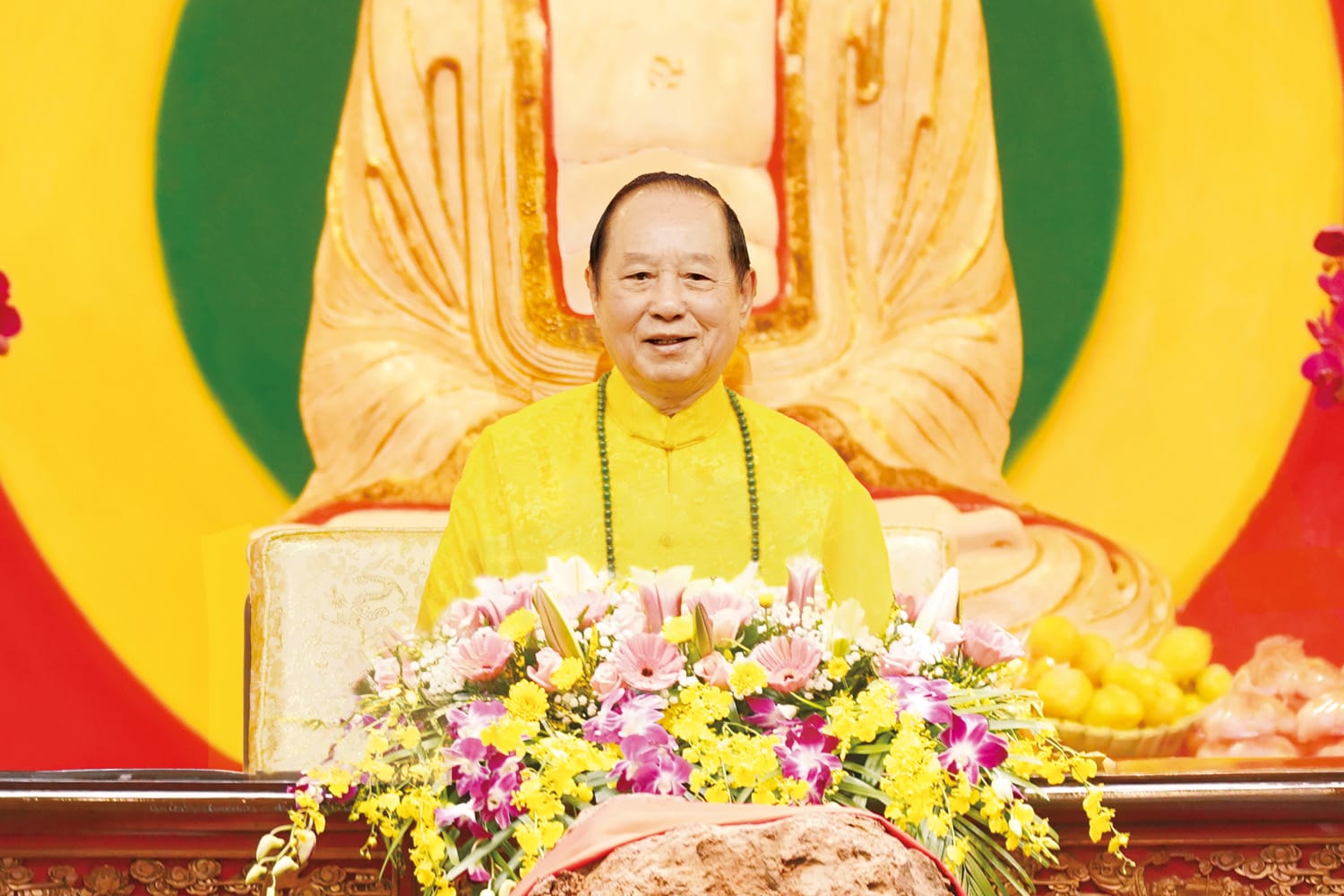
Dharma Teachings: Grandmaster Wu Chueh Miao-Tien, the 85th-Generation Grandmaster of Buddhist Zen School
Chinese content prepared by: Hsieh Ming-Yuan, Hsieh Ai-Chu
Photographs Courtesy of Shakyamuni Buddhist Foundation
Preach by: Zen Master Wu Jue Miao Tien, the 85th Patriarch of the Zen School
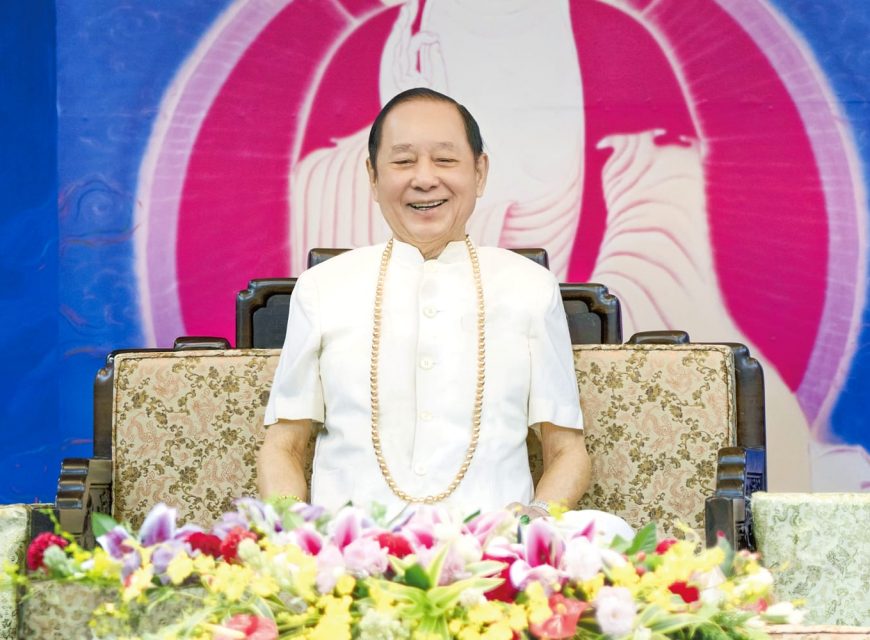
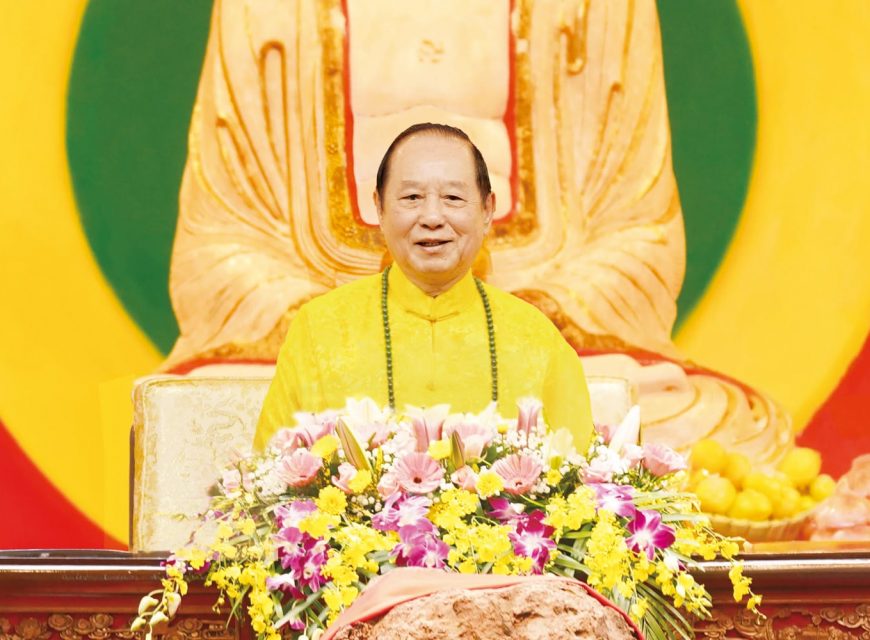
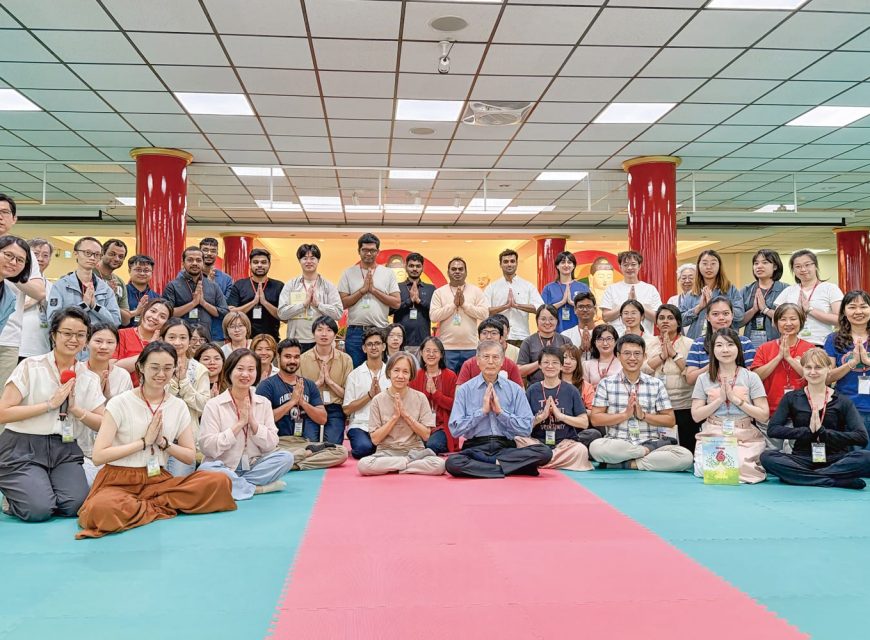
On June 6, 2026, at 10:00 a.m., the 85th-generation Zen Grandmaster of the Buddhist Zen School, Grandmaster Wu Chueh Miao-Tien, delivered a Dharma talk and teachings to disciples worldwide, participating both on-site and via live video stream at the Shakyamuni Buddhist Foundation’s Great Zen Hall in Nangang District, Taipei City.
To check on the disciples’ progress in their practice, Grandmaster Wu Chueh Miao-Tien specially invited everyone to submit written questions, which he addressed before beginning the formal Dharma teaching session.
Q1: The disciple does not grasp the key point of “Zen meditation focusing on the chakras by anchoring spiritual energy in the chakras.” I wish to hear a detailed explanation.
A1: Spiritual power is an energy form higher than the material level, allowing us to transcend the material plane. During Zen meditation, one must concentrate all spiritual and mental energy—including all affections and every available resource—fully into the chakras. Starting from a single chakra, operate and guide them one by one. In fact, guiding qi is much like playing with a ball; just as you control a ball’s movement in your hand, focusing on the chakras is about guiding qi to transform it into electricity and light. Therefore, diligent practice is essential.
Q2: Work often drains physical and mental energy. How can we quickly restore our physical and mental state?
A2: Many people experience this—working hard every day and feeling completely exhausted, especially engineers. How can you recover immediately? It starts with the foundational practice of working with the ten chakras. How do you do it?
Connect with the ten chakras in the present moment, align them, and unify them in the Zen Chakra during Zen meditation. Then, allow the energy to flow down through the cerebellum and discharge throughout the entire body. Once you feel that your hands and feet are fully energized and connected, you will be able to recover quickly. Therefore, it is important to practice this regularly.
Q3: How can one remain in the joy and freedom of their true nature despite changes in the external environment?
A3: The joy and freedom of one’s true nature are not affected by changes in the external environment. It is because your heart is not at ease that you do not feel true joy. Initially, you may not feel this joy simply because you have not yet found your Buddha-nature. Once you find it, you will feel joyful and happy every day. Therefore, it is only because you have not yet realized your Buddha-nature that you are easily influenced by the outside world. The most important thing is to first calm and settle your heart so that it is not swayed by external conditions. When your heart is pure, stable, and able to abide peacefully, it will remain completely unaffected.
Q4: A disciple is struggling to grasp the essentials of “resonating with Shifu, resonating with the chakras, and resonating with the Buddhas and Bodhisattvas,” and wishes to hear a detailed explanation.
A4: If you cannot even resonate with your own ten chakras, how can you attune yourself to Shifu or the Buddhas and Bodhisattvas? So-called resonance (attunement) is simply a matter of using your heart and mind. You fail to resonate because you didn’t put your heart into it. For example, when I listen to music, I listen with my heart, not just with my ears. There is emotion within the music; by listening with my heart, I can resonate with that emotion, which makes good music sound even more wonderful. You must attune to it with your heart and resonate with it.
How, then, do you resonate with the ten chakras? Through concentration. Take the Navel chakra as an example: when focusing on it, you must first realize that Navel chakra is inside your own body. How do you get in touch with (tune into) your body? By dedicating your entire spirit to the Navel chakra. How do you dedicate it? This is the heart dharma. You must pour all your spiritual energy into the Navel chakra to resonate with it and activate its energy. Therefore, your “heart needs to be in it” and your “spirit power needs to be in it,” maintaining single-mindedness. You must focus on the chakra like this without distraction for at least ten minutes, feeling it, and only then will you experience a response.
Q5: The disciple wishes to gain a deeper experience of gratitude and repentance, and humbly asks for detailed guidance.
A5: Speaking of gratitude, especially when receiving kindness from others, we must know how to appreciate it and repay it. For example, our elders, our teachers, and those who have helped us—when we receive their grace, we should know how to be grateful. As for repentance, when we do something wrong, we must repent and correct our mistakes. This is what repentance means.
Q6: Why do I feel nothing when focusing on Navel Chakra?
A6: You must be dedicated and put in the work to practice. How do you put in the work? Just like working—you must focus single-mindedly on your job; spiritual cultivation similarly requires single-minded focus, and it must be done with the inner strength (the power of your spirit).
Q7: What is spiritual resonance? How can one be certain they have achieved resonance rather than falling into the illusions of the conscious mind?
A7: If you are uncertain whether you have achieved spiritual resonance, then you certainly have not. How to determine that you have not fallen into the illusions of the conscious mind—this is the very issue of spiritual resonance.
The Heart-Imprint Buddhist Dharma taught by Shifu is the genuine transmission passed down from the World-Honored One. Directly within the formless realm, Shifu transmits the entire heart—including the energy and wisdom of the Holy Spirit—as ultimate reality directly into your heart. Therefore, you must listen with your heart, resonate with Shifu with your heart, and let your spirit echo Shifu’s words. When you fully dedicate your spirit, emotion, and mental strength into what Shifu says and bring Shifu’s words into the body, mind, and spirit, you will feel the power. This is the practice of spiritual resonance.
Shifu transmits the Buddha’s Heart-Imprint, which is the genuine transmission from the World-Honored One—this is our Heart-Imprint Buddhist Dharma and Heart-Imprint Zen Dharma. Today, Shifu is the only one in the world truly transmitting the Heart-Imprint, so you should also practice using the same method (spiritual resonance and heart-to-heart imprint).
I transmit the realization power of the Buddha—obtained and inherited through my entire heart—directly to you right now. You must resonate and echo with it. To resonate together in spirit, emotion, and all aspects is equivalent to uniting with Shifu and responding. Through response, true spiritual resonance arises from within.
Q8: How to get electrified (achieve electricity-energy flow)? During Zen meditation, I only experience the flow of qi and can see light, but I cannot experience the electricity-energy flow.
A8: Without electricity, where would light come from? Where there is light, there is electricity—you just don’t feel it yourself. Where does this electricity come from? Is it your own, or is it the energy received on the spot during class? These two are different. I hope everyone can achieve this electrical flow.
During Zen meditation, when you reach the point where qi can flow naturally and smoothly, you will be electrified. In other words, you must be able to direct your qi—for example, if you want it to move east, it goes east; if you want it to move west, it goes west. Once everything unifies, it becomes unified. When you reach this level, you can transform qi into electricity, and your energy will become even stronger.
This electricity is just like telepathy; both rely on heart dharma, rather than using your ordinary thoughts or conceptual thinking to transform it—it will not work. You can only change it naturally by elevating the energy level, depth, and height of your qi. As long as you are able to master and guide it, you can utilize it.
This “electricity” is a term I use. Transforming the energy of qi into the energy of electricity is not something ordinary people can achieve, so you must work twice as hard to accomplish it.
Q9: How can one let go of worldly desires? I keep wanting to get rich and make a fortune, and I cannot maintain a state of purity.
A9: If you want to practice spirituality, you should not think about getting rich. Let everything follow its natural course; contentment brings constant happiness.
Most people want to become multi-millionaires, but a multi-millionaire is just an ordinary person. A truly superior individual is someone who knows contentment and is happy with what they have. Of course, if wealthy people can use their money to benefit all living beings, that is also very good.
Now, what is a sage? A sage is someone who practices the Heart-Imprint Buddhist Zen. So, do you want to be a sage? A lofty person? Or an ordinary person? Think about it for yourselves.
Q10: When facing non-practitioners, we are often attacked by their negative remarks. How should we respond?
A10: The sixth rule of the Ten Dharma Seals of Zen (Note), “Not being angered by evil forces,” gives you the answer. These Ten Dharma Seals of Zen are not meant for you to merely recite, but to put into actual practice. If you can fulfill all ten of these, your spiritual practice will be up to standard, you will enter the rank of sages, and your formal practice will truly begin. If you can fulfill the first eight, you will attain great purity, and your wisdom will grow.
(Note) Ten Dharma Seals of Zen:
- Not being misled by self attachment.
- Not being confused by form attachment.
- Not being deluded by fame and fortune.
- Not being tormented by material desires.
- Not being swayed by illusions.
- Not being angered by evil forces.
- Not being trapped by infatuation.
- Not being disturbed by worldly affairs.
- Having a bright and upright heart.
- Possessing vast and boundless wisdom.
Q11: Shifu said to “transform the Age of Moral Decline into the Age of True Dharma.” However, it is still currently the Moral-Decline Age—when will it officially become the Age of True Dharma, and what is that process like?
A11: For the True-Dharma Age to truly arrive, you must all go out to propagate the Dharma and spread the Heart-Imprint Buddhist Zen. Only then will the True-Dharma Age arrive earlier; otherwise, it will remain the Moral-Decline Age (the Age of no Dharma).
What is the Right Dharma? It is the true Buddha-Dharma—the Buddha-Dharma that can enable one to attain the status of a sage: a sage on earth and a Buddha in heaven, which is also known as a holy spirit. You must understand this process: how it enables us to transform our ordinary human nature into Buddha-nature, and ultimately into a holy spirit.
However, this belongs to the spiritual realm and the dimension of spiritual wisdom. In the human world, you cannot conceive of it nor accomplish it through thought alone. Therefore, it requires this kind of spiritual wisdom (prajna), which I will reinforce for everyone during class.
Q12: In today’s era of AI, if all work is handled by AI, will people no longer need to be busy with work and instead live a relaxing life, while also having spare time to care for one another, rediscover their true nature, elevate their spirituality, and achieve a Great Commonwealth (Utopian) world?
A12: Based on the question, are you saying you will wait until all work is done by robots and you no longer have to work before you start practicing spiritually? That is incorrect.
Because robots are composed of physical matter combined with an artificial brain, they can perform simple tasks, and in the future, they might gradually handle deeper tasks and replace humans in certain areas—such as taking care of the elderly or looking up information.
But no matter how advanced it may become in the future, it is still matter. When development in the material world reaches its peak—even to the point where this matter can operate with a “spirit” like a human being and perform tasks just like a person—that is reaching the pinnacle of technology, which is science and technology.
However, humans do not know or understand that there is a Law (Dharma) far deeper and higher than high technology, which exists in heaven and not on earth. What is that? It is Buddha-nature, spirituality, and the Holy Spirit.
The Holy Spirit is the living energy of all wise beings, a wise conscious life. Generally, a physical body in the human realm, such as a human being, has a lifespan of several decades or up to a hundred years; but the life of the Holy Spirit extends far beyond that—that is the energy of spirituality.
Why do humans age? Why do people die? Because humans are physical beings, and to maintain the life energy of this physical body, we need to eat food. In addition, the human body is also affected by climate changes; for example, in winter the northwest wind blows, while in spring and summer the southeast wind blows. Therefore, the southeast wind has a warming and nourishing effect on the human body, whereas the northwest wind is harmful to the human body. In ancient times, farming followed the saying “spring plowing, summer planting, autumn harvest, winter storing,” which operated in accordance with changes in the weather.
Living in the human realm, we should understand that there are truly important matters beyond this world. If you can learn from Shifu how to attain the highest Holy Spirit, you can master and embrace this world, rather than being oppressed by it—being oppressed in your life and work, encountering many difficulties, and living a weary, arduous, painful, and sorrowful life under that oppression.
Therefore, you must possess life energy of high-level wisdom and wisdom energy capable of mastering the wisdom energy of the entire planet. Only then can you be a true Holy Spirit, able to live in another world of the Holy Spirit—which is a world of sages.
Today, Shifu shares these wise reminders with you. You should enrich yourselves and pursue this direction, rather than simply drifting aimlessly through life on Earth, fighting with others for fame and fortune, or getting angry and upset over trivial matters. That is not good.
Someone once asked how Madam Chiang-Soong, Mei-ling managed to live to the ripe old age of 103. She replied, “Because my mind knows how to pick things up, put them down, and let them go with an open perspective.” Therefore, everyone should understand that nothing in this world is worth grieving over. The more you fail, the more you must strive to forge ahead—you must be able to “pick things up.” When an opportunity arrives, you must have the courage to take responsibility—you must be able to “take it on.” Even if you happen to fail, there is no need to lose heart; you must be able to “put things down” and “let them go,” and start all over again. Such people belong to the highest caliber.
Q13: I am from India, have been practicing for nearly two months, and am currently a postdoctoral researcher in the Department of Mechanical Engineering at National Taiwan University. As a disciple of the Zen lineage, I hope to have the opportunity to follow Shifu in spreading the Buddha’s Dharma everywhere, becoming a “Dharma Cloud Bodhisattva” who spreads the teachings like drifting clouds. Please allow this disciple to ask you: Grandmaster Yiming taught in the foundation class that one must practice even more diligently during the process of enlightenment. May I ask Shifu to explain in more detail how a disciple should practice more diligently? Also, what is inside the chakras? When entering the chakras, does one witness the changes in the chakras from a state of transcending or detaching from them?
A13: Working diligently is just like pursuing a doctoral degree: you dedicate yourself earnestly to your coursework, studying with all your heart. How do you internalize the philosophy within it, or how do you apply those principles more deeply? That is diligence in scholarship.
Practicing Zen is the same way: you must comprehend it more deeply with your heart, experiencing it with your entire body and all your spirit. Because the ten chakras I teach are all inside the body, you must connect with the body. Just thinking about it with your mind does not count as diligence. Instead, you must single-mindedly direct your focus into the chakras and into the body, directly touching the chakras and touching the body.
Ordinarily, we use our hands to touch the body, but in fact, we can also use “spirit” to make contact. For example, by focusing your eyes on the center of your palm, you can make contact with it. This is outside the physical body, where you can use your eyesight to see and touch the body.
However, the chakras inside the body cannot be seen; how do you make contact with them? You must feel them with your spiritual strength and sense their location through your nervous system. Therefore, figuring out the method to make contact with them (the chakras) is what we call diligence.
As for what is inside the chakras—they are entirely made of life energy. The purpose of focusing on the chakras is to touch this life energy and develop it so that it enhances your vitality.
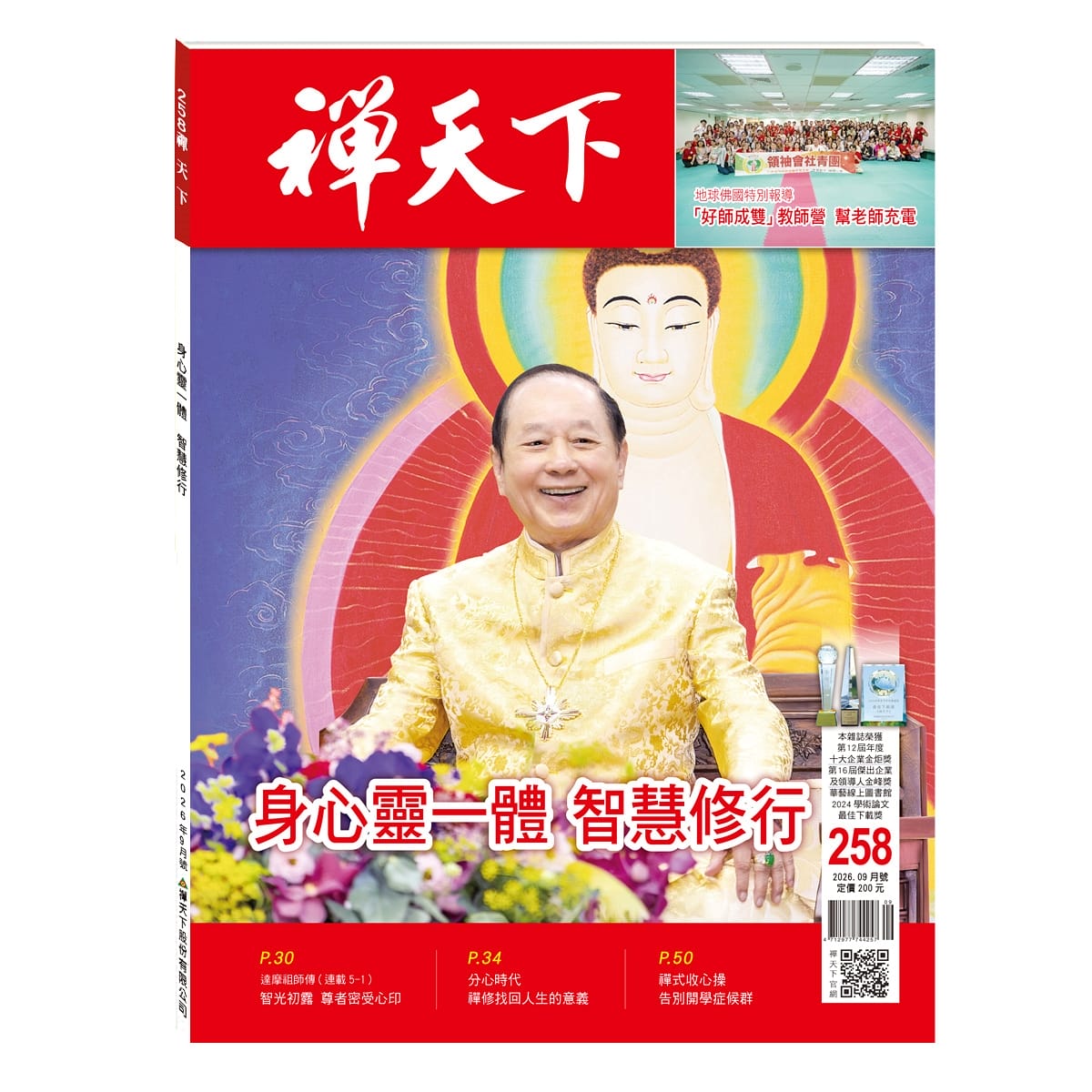
Due to an enthusiastic response with many questions, and in order not to disrupt the class, Grandmaster Wu Chueh Miao-Tien first answered this initial batch of questions before officially beginning the transmission of the Dharma. For the complete teachings of the Zen Grandmaster, please refer to the Special Report in issue 256.
English Translation: Chueh Miao Dao-Lian
|
|









關注我們
加入Line@官方帳號